Can You Negotiate on Used Cars?
Yes, used-car prices are usually negotiable, and dealer fees and some add-ons sometimes are too. Taxes, title, and registration are generally fixed by law or state schedules. Miss that split, and you can overpay or push on the wrong line item. This guide shows where your room is with dealers and private sellers, and which costs are fixed.
Where the negotiating room usually
Yes, in many situations you can. Negotiating used cars can happen at a dealership or with a private seller, but the room depends on market value, demand, condition, and how much flexibility the seller has. Start with market value, not the window sticker.
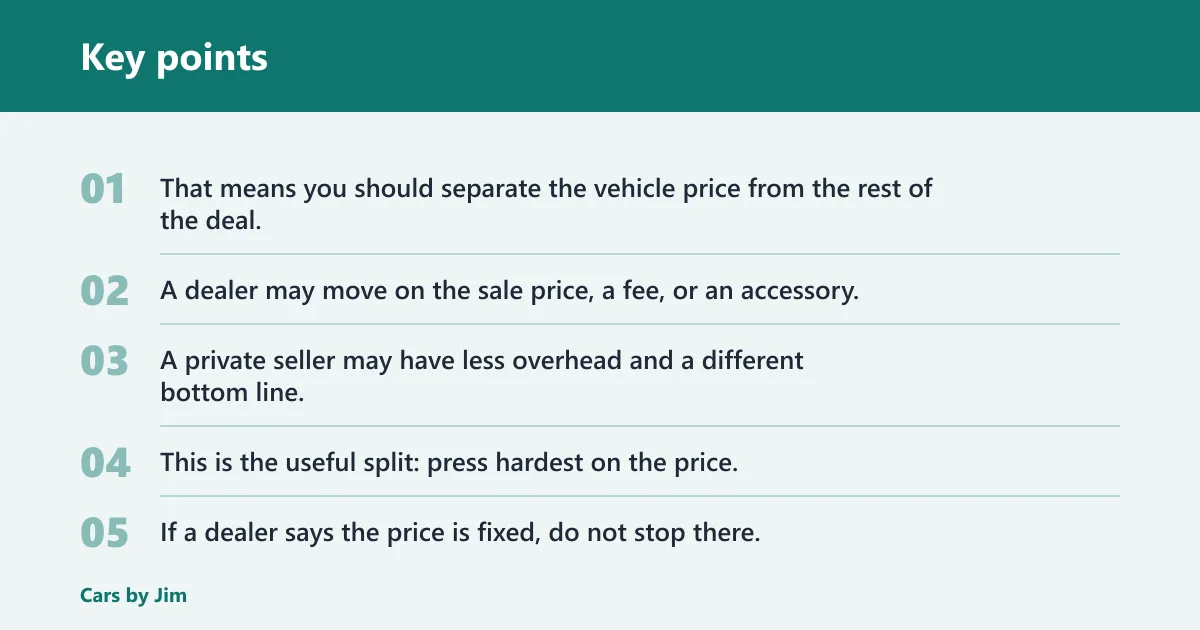
That means you should separate the vehicle price from the rest of the deal. A dealer may move on the sale price, a fee, or an accessory, while taxes and many government charges stay fixed. A private seller may have less overhead and a different bottom line, but the same basic logic applies.
Used-car negotiation matrix
| Line item | Usually negotiable | Sometimes negotiable | Usually fixed | How a dealer may defend it |
|---|---|---|---|---|
| Vehicle asking price | Yes | Yes, if demand is weak | No | “We priced it off market demand and reconditioning costs.” |
| Dealer documentation fee | Yes, in some stores | “This is a standard dealer fee.” | ||
| Dealer transport fee | Yes, Progressive says it may be negotiable | “We had to move the car from another location.” | ||
| Reconditioning repairs | Yes, as a concession or repair | “The car already passed our shop review.” | ||
| Accessories or add-ons | Yes, if not installed or required | Sometimes, if already on the car | “That package is already included in our pricing.” | |
| Taxes | Usually fixed | “Sales tax is set by law.” | ||
| Title and registration | Usually fixed | “Those are state charges.” | ||
| Financing rate | Sometimes, if the lender allows it | “Your rate depends on credit and lender terms.” |
This is the useful split: press hardest on the price, then on dealer-controlled fees and add-ons, and leave legal or government charges alone. If a dealer says the price is fixed, do not stop there. Ask what else can move in the out-the-door number.
How to set your target price
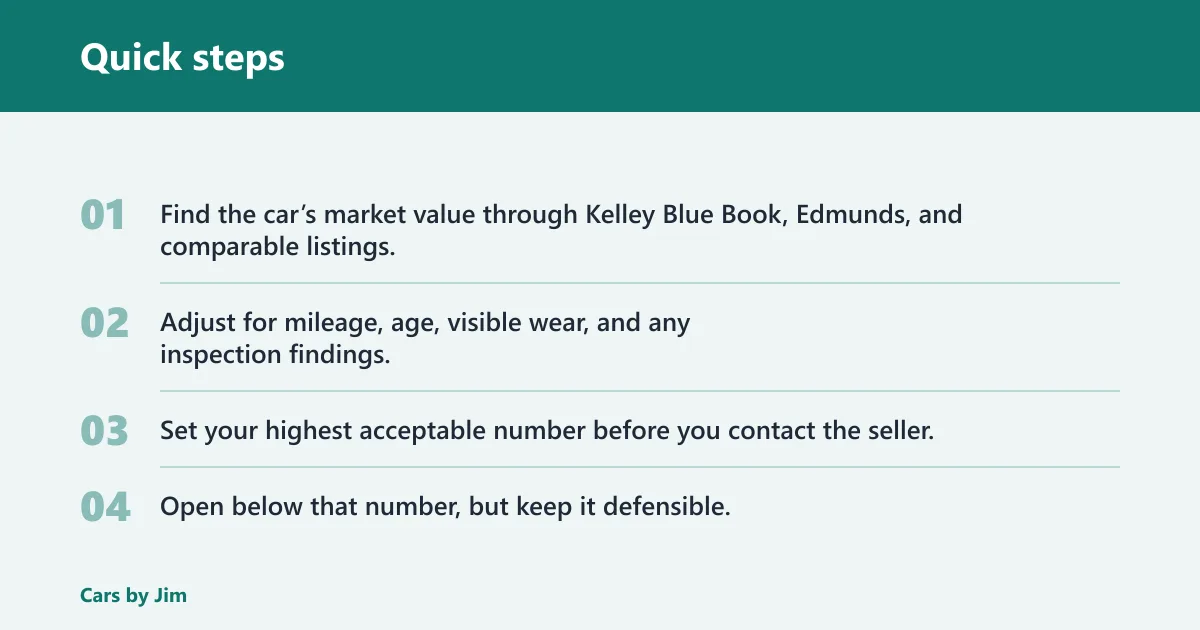
Use market value as your target, not the window sticker or the first quote. NerdWallet says to begin by looking up the car’s current market value, and Progressive says a fair target is market value. Check Kelley Blue Book and Edmunds, then compare those figures with comparable local listings for the same model, trim, mileage, and condition.
That comparison matters because condition changes room to negotiate. Mileage, age, cosmetic wear, tire life, warning lights, and service history all affect what the car is worth in your market. A clean history on a common model leaves less room than a car with obvious wear or a problem that shows up on an inspection.
Suppose two sedans are the same year and trim. One has 62,000 miles, fresh tires, and a clean inspection report; the other has 91,000 miles and a worn brake pad set. The second car gives you more room to ask for a lower price, because the next owner will absorb those costs right away.
Use a realistic opening offer
Consumer Reports suggests opening around 15% to 25% below the price you are willing to pay, especially when the car has room to move or the seller is motivated, and NerdWallet recommends a low but realistic opening offer. That does not mean you anchor to an extreme low number. It means you leave room for a counteroffer and still protect your ceiling. (Consumerreports)
- Find the car’s market value through Kelley Blue Book, Edmunds, and comparable listings.
- Adjust for mileage, age, visible wear, and any inspection findings.
- Set your highest acceptable number before you contact the seller.
- Open below that number, but keep it defensible.
Should you get preapproved first?
Yes. Auto loan preapproval helps separate price negotiation from financing, and it can keep the conversation focused on the sale price instead of the monthly payment. If you walk in without it, a dealer can steer attention toward payment length, which can hide a high price or costly add-ons.
Preapproval also gives you a cleaner comparison point. You already know what your lender offers, so you can judge the dealer’s rate, fees, and total cost against that baseline. That makes the out-the-door number easier to challenge.
How preapproval changes the dealer conversation
With preapproval, you can say you are negotiating the car, not the financing. That matters when a dealer tries to trade a lower payment for a longer term or extra products. The deal should stand on its sale price and total cost, not on a stretched monthly figure.
A common first-timer mistake is asking, “What can you get me to per month?” That question weakens your position. Ask for the selling price, the fee list, and the out-the-door total instead.
What to say when the price is firm
If the price is firm, do not stop negotiating. Ask for fee waivers, recon work, accessories, or an out-the-door adjustment. Progressive notes that a dealership may have a strict price floor on some models, so the fallback is often not the sticker price itself, but the rest of the deal.
Turn inspection findings into a dollar ask, not a vague complaint. The same source recommends a mechanic inspection before finalizing the deal. If the inspection shows worn tires, uneven brake wear, or a warning light, ask for a repair, a credit, or a lower out-the-door figure.
Example: if the front tires are close to replacement and the brake pads are near the wear limit, ask the dealer to replace them or reduce the price enough to cover the work. A general “the car has issues” argument is weaker than a specific repair list.
Set your walk-away point before you counter
Decide your final offer before the back-and-forth starts. Consumer Reports advises setting a final offer and being ready to walk away, and NerdWallet includes walking away as part of the process if agreement fails. If the seller will not meet your limit, leave.
Counteroffers should move in small, planned steps. The same source says to move in small increments if you must raise your offer, and Progressive says to be ready with a counteroffer if the seller changes the price. Do not chase the deal with random jumps.
Dealer vs private seller
Dealers and private sellers negotiate differently. A dealer may have more structure, more fees, and more room to adjust the paperwork or add a concession. A private seller often has less overhead and may expect cash or a cashier’s check, which can make the conversation simpler but also more direct.
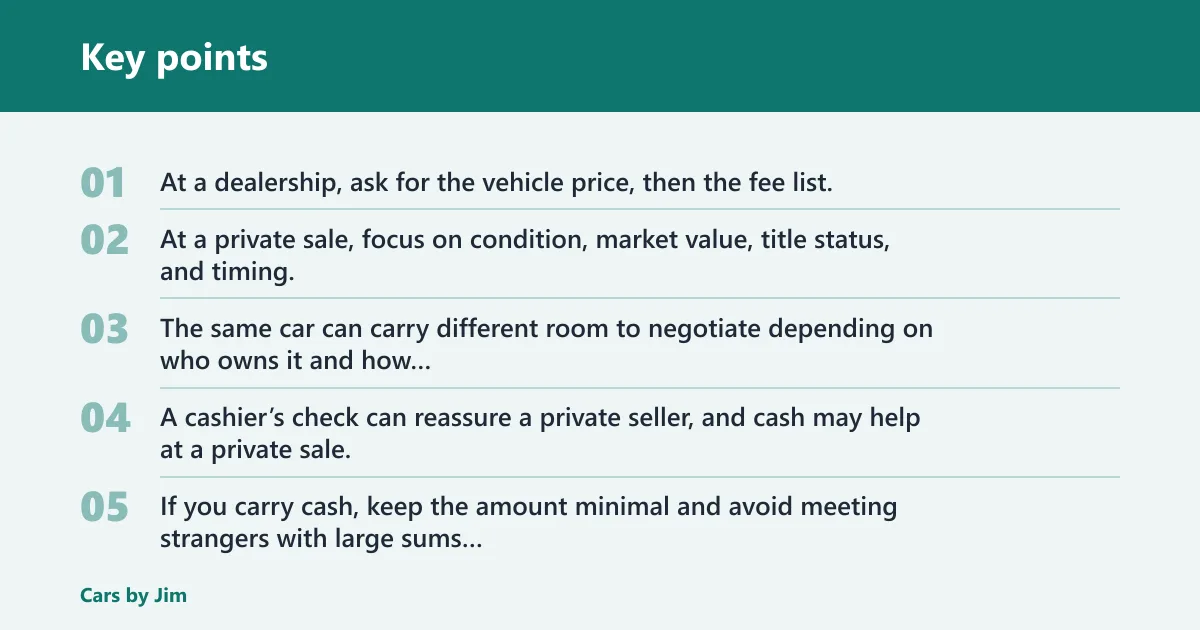
At a dealership, ask for the vehicle price, then the fee list, then the out-the-door total. At a private sale, focus on condition, market value, title status, and timing. The same car can carry different room to negotiate depending on who owns it and how quickly they want to sell.
What to bring when paying cash or by cashier’s check
Bring proof of funds and a clear limit. A cashier’s check can reassure a private seller, and cash may help at a private sale, but neither should replace an inspection or a title check. If you carry cash, keep the amount minimal and avoid meeting strangers with large sums on hand. The payment method is useful; it is not a substitute for due diligence.
If the seller wants speed, you can use that as room for a modest price adjustment or a fee concession. If the car is in high demand, keep your offer disciplined and avoid acting urgent. High-demand models and low-inventory listings often leave less room to negotiate, including on certified pre-owned vehicles, though CPO pricing can still vary a lot by brand, age, and local supply.
Common mistakes that weaken your offer
One mistake is negotiating only the monthly payment. That can hide a higher sale price or a longer term. Another is ignoring fees and add-ons, especially dealer-controlled items that may be negotiable. A third is skipping the inspection or the market-value check and then making an offer in the dark.
Modern buying channels matter too. Online-only pricing, chat negotiation, and no-haggle chains can still involve room on fees, accessories, or the out-the-door total, but the room may be tighter. If the seller will not move and the numbers do not fit your target, keep shopping.
Can you make a low offer on a used car? Yes, as long as the offer is tied to market value, comparable listings, and condition. A low opening bid works best when it is still realistic and leaves room for a counteroffer. Too low can shut down the conversation.
Frequently asked questions
Can you negotiate on used cars at dealerships?
Yes. You can negotiate on used cars at dealerships in many cases, although the dealer may be firm on some models or on the price itself. If that happens, shift to fees, add-ons, repairs, or the out-the-door total. Market value is still the benchmark.
Can you haggle on used cars?
Yes, but haggle with a target, not with a guess. Use Kelley Blue Book, Edmunds, and comparable local listings to set your range. Then make a low but realistic opening offer and be ready to counteroffer if the seller pushes back.
Do you negotiate on used cars or accept the sticker price?
Do not accept the sticker price automatically. Used-car pricing is often negotiable, and the better move is to compare the ask with market value and the vehicle’s condition. If the seller will not move on price, ask about fee waivers or other concessions.
Can you negotiate used car prices with a dealer?
Yes. Dealers often have some flexibility, even when they cannot move much on the sticker price. You may get a concession through a fee waiver, a repair credit, or an out-the-door adjustment. Preapproval helps keep that discussion focused on the car, not the financing.
How much can you negotiate on a used car?
There is no fixed amount. The room depends on market value, mileage, age, condition, demand, and whether the seller has a price floor. High-demand and certified pre-owned vehicles usually have tighter margins, while older cars with clear wear may give you more room.
Can you negotiate on a used car from a private seller?
Yes. Private sellers often have less overhead than dealers and may be more flexible on price, but they may also want fast payment by cash or cashier’s check. Negotiate based on condition, title status, and comparable listings, and do not skip the inspection.