VIN Check: How to Verify a Used Car’s History
Verify a used car’s history by first matching its 17-character VIN to the title, registration, dashboard, and door label, then running it through NHTSA and a history report before you make an offer. Skip that order and you can miss theft, cloning, salvage branding, odometer rollback, liens, or flood damage that can cost thousands. This guide lays out a VIN-check workflow to confirm identity, spot fraud signals, and decide whether to inspect, negotiate, or walk away.
What a VIN check can confirm and what it cannot
What a VIN-based search confirms well
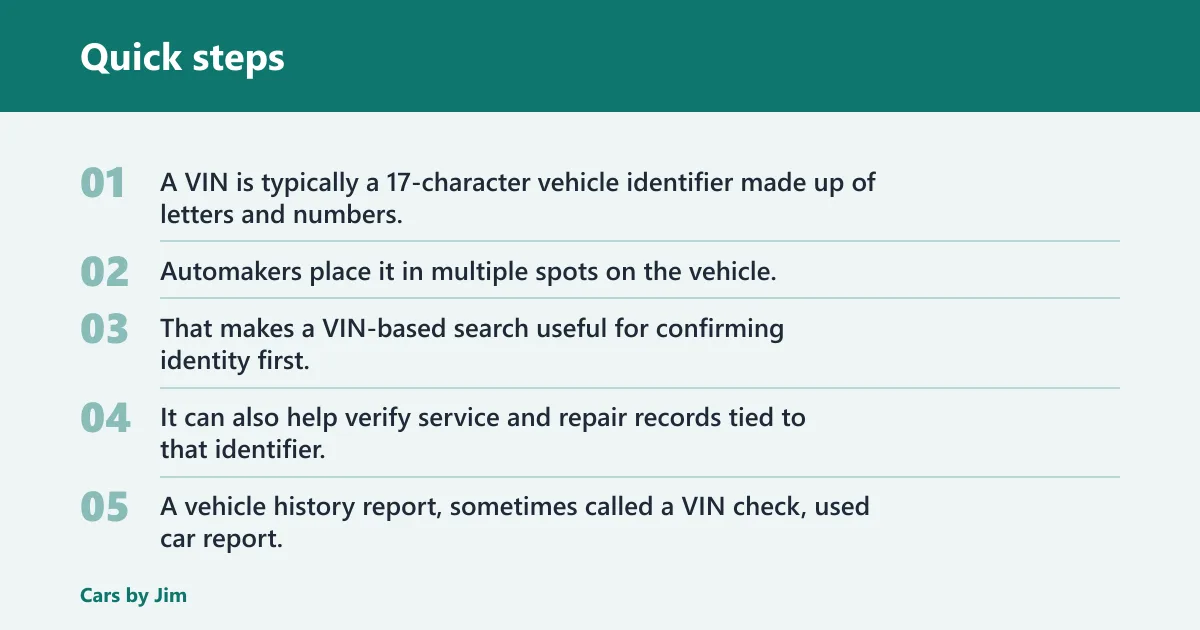
Automakers place it in multiple spots on the vehicle, and it also appears on the registration certificate.
That makes a VIN-based search useful for confirming identity first. It can also help verify service and repair records tied to that identifier, then surface title status, mileage points, theft records, open recalls, and ownership pattern across available databases.
A vehicle history report, sometimes called a VIN check, used car report, or car history report, may include accident history, title status, odometer records, ownership and registration records, auction history, theft records, salvage history, and cross-region registrations. Private reports often add maintenance logs and usage clues such as personal, rental, fleet, taxi, or government service.
What a VIN check cannot prove on its own
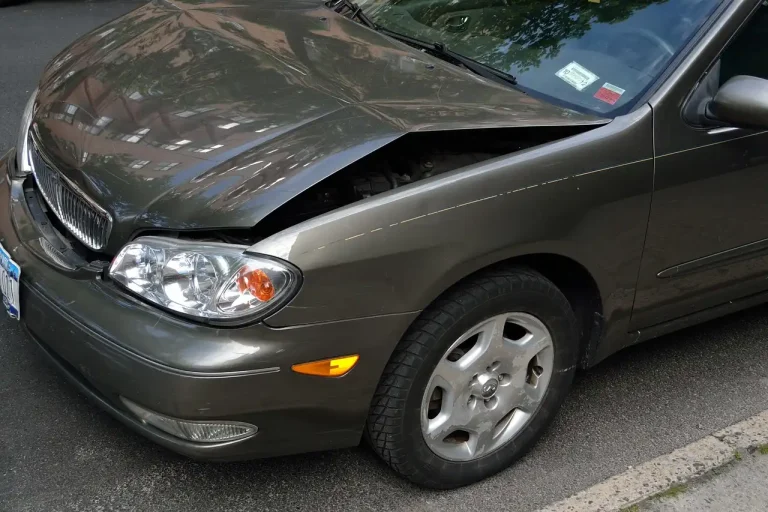
A clean report does not prove a clean car. A VIN lookup can reveal accident, flood, fire damage, structural modifications, and odometer tampering, but it cannot prove repair quality, current mechanical condition, frame alignment, or hidden water damage that never reached an insurer or auction.
It also cannot guarantee that every accident appears. Records can be delayed, incomplete, or missing, especially on imported vehicles, gray-market cars, rebuilt-title cars, or cars repaired privately.
Without a VIN, a vehicle generally cannot be legally registered or driven on public roads. If the VIN is missing, altered, or inconsistent, solve the identity problem before you read any report.
What you’ll need
- The VIN from the car itself, not only from an online listing
- The title, registration, insurance card, and bill of sale
- Any loan payoff, lien release, or dealer stock paperwork if applicable
- Seller service records, inspection receipts, and repair invoices
- Access to the manufacturer or NHTSA recall search and a theft check source
- One commercial vehicle history report for broader title, mileage, auction, and ownership data
- A note-taking sheet for dates, mileage entries, mismatches, and next actions
- The license plate number as a fallback if the VIN is temporarily unavailable
How do you tell whether the VIN on the car matches the paperwork?
Match the VIN character-for-character across the car, title, registration, insurance card, bill of sale, lien papers, and listing before reading any history report. A single mismatch can be a clerical error, but altered labels, odd rivets, missing stamps, or inconsistent fonts are stronger walk-away signs.
Check every visible VIN location
Start with the VIN plate visible through the windshield at the driver-side lower corner of the dashboard. Then check the driver-door jamb label, an engine-bay or body stamp, and the key documents the seller provides.
The VIN on the car must match the title, registration, insurance card, bill of sale, loan or lien paperwork, and any dealer listing. If a seller says one digit is probably a typo, verify it against at least two physical vehicle locations before you accept that explanation.
Look for tampering, not only digit errors
Mismatched fonts, scratched paint around a plate, fresh adhesive, disturbed trim, non-factory rivets, or a door-label edge that looks lifted deserve extra scrutiny. Those signs matter because the visible label may have been replaced while a stamped body location was not.
Say your dashboard VIN matches the title, but the door-jamb label shows a different eighth character and the label corners look newer than the surrounding paint. Treat that as an identity problem first, not a paperwork problem. Do not move on to pricing until the seller produces a convincing documentation trail.
Separate clerical errors from identity fraud
An innocent mismatch usually leaves a paper trail: corrected registration paperwork, a state-issued amended title, or a dealer disclosure tied to the same VIN on the car. A fraudulent or cloned-car pattern usually combines a mismatch with tampering signs, missing records, or a seller who avoids stamped-location checks.
When the physical VIN and the title do not match, the safest default is to stop. A pre-purchase inspection cannot fix an identity problem.
Which VIN records are free and which usually require payment?
Free checks usually cover basic VIN decoding, open recalls through NHTSA or manufacturer tools, NICB stolen-vehicle screening, and sometimes thin title data, while fuller accident, auction, ownership, mileage-event, and registration history usually requires a paid report. Dealer-provided reports can help, but they still need cross-checking against official recall and theft sources.
What is commonly free?
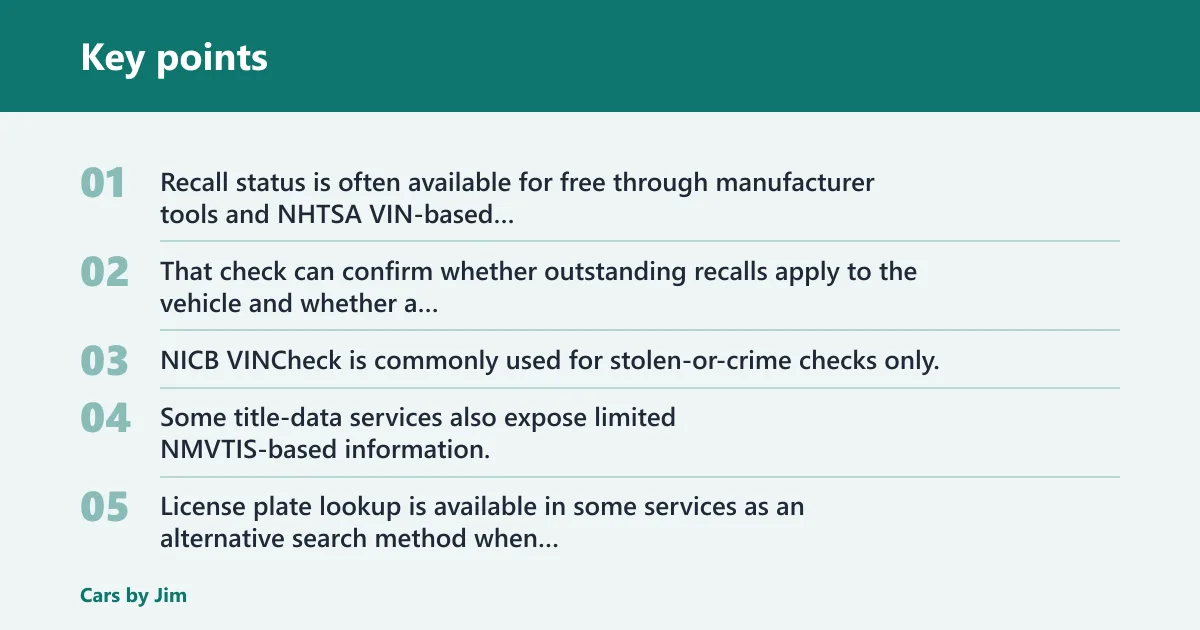
Recall status is often available for free through manufacturer tools and NHTSA VIN-based searching. That check can confirm whether outstanding recalls apply to the vehicle and whether a remedy still appears open.
Some theft data is also free. NICB VINCheck is commonly used for stolen-or-crime checks only, which makes it useful but narrow.
Basic VIN decoding is typically free. Some title-data services also expose limited NMVTIS-based information, though the level of detail varies.
License plate lookup is available in some services as an alternative search method when the VIN is unavailable, but it is less direct than a VIN-based search and should be treated as a fallback, not a substitute.
What usually requires payment
Commercial reports usually add ownership records, maintenance logs, accidents, odometer discrepancies, cross-region registrations, auction history, salvage history, and broader event timelines. Sapling notes that only CARFAX offers full reports for free, while other services usually charge.
That does not make one paid report complete or final. Different sources pull from different reporting streams, so a buyer should compare official recall and theft checks with at least one commercial vehicle history report and the seller’s own paperwork.
How to use a dealer-provided report
A dealer report can save time, but it should not be the only source. Confirm the VIN on the car, run the recall check independently, and compare the dealer’s report against title brand language, mileage sequencing, and seller disclosures.
Suppose a dealer report looks clean but the service records show an out-of-state gap of two years and the title application date does not line up with the first local registration. That does not prove fraud, but it does justify another report or a title-data cross-check before any deposit.
How do you check a used car’s history from the VIN?
Check a used car’s history by treating the VIN search as a sequence, not a single download. Match the VIN on the car and paperwork first, run free official checks second, pull a commercial history report third, then turn the findings into one of four decisions: continue, inspect, negotiate, or walk away.
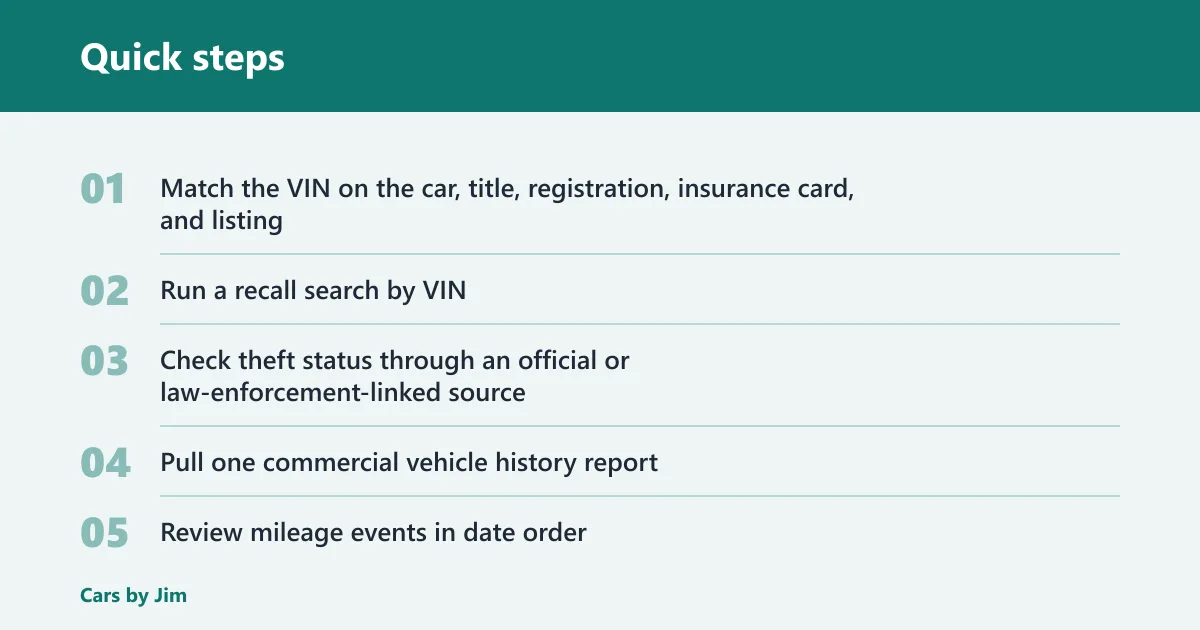
Verification workflow
- Match the VIN on the car, title, registration, insurance card, and listing. Do this before reading any report, because the wrong car can still produce a real history file.
- Run a recall search by VIN. Check whether any recall is open and whether the remedy still appears incomplete, because recall status is separate from accident history.
- Check theft status through an official or law-enforcement-linked source. A stolen-vehicle flag changes the deal immediately, though delayed database updates remain possible.
- Pull one commercial vehicle history report. Read title brands before accident entries so a salvage, rebuilt, flood, fire, junk, or lemon history is not buried under other details.
- Review mileage events in date order. Mark drops, long gaps, duplicate entries, and out-of-sequence readings from inspections, service visits, registrations, or auctions.
- Check ownership count, ownership duration, and usage type. Personal use usually reads differently from rental, fleet, taxi, or government service.
- Compare damage entries with seller disclosures and invoices. An admitted bumper repair with matching paperwork is different from an undeclared structural repair or repeated auction notes.
- Flag imports, gray-market records, rebuilt titles, and no-record VINs. Those cases need extra documents, not assumptions.
- Choose the next action. Continue if the file is consistent, require a pre-purchase inspection if the story mostly holds, renegotiate if the issues are priced-in and repairable, or walk away if identity, theft, title, or mileage problems remain unresolved.
How to read title brands in plain language
Salvage usually means the vehicle was declared a total loss. Rebuilt means it was later repaired and returned to road use, but the prior total-loss history still matters. Junk is the hardest stop, because that label usually means the vehicle was not meant to return to normal road use.
Lemon points to a buyback or persistent defect history. Flood and fire brands demand extra caution because corrosion, wiring damage, and smoke or heat damage can appear long after cosmetic cleanup.
How to interpret mileage history without overreacting
One missing interval is different from a pattern. A single skipped service visit may mean nothing if the rest of the record moves upward in a believable way.
A rollback pattern looks different: mileage drops between events, jumps backward after auction or registration entries, or repeated round-number entries that break the date order. When that happens, ask for dated service invoices and inspection records, then price the car as if the odometer claim is unproven unless the gap is cleared.
What red flags matter most in a VIN check?
The biggest VIN-check red flags are identity mismatches, altered or missing VIN markings, branded titles, odometer rollbacks, theft hits, unresolved recalls, and conflicting records across sources. Ownership churn, repeat auction appearances, and a seller story that does not fit the paperwork are weaker signals alone but stronger together.
Identity red flags
The most serious red flags come before the report. A missing VIN plate, altered label, mismatched stamped location, or format problem means the vehicle’s identity is in doubt.
That includes no-record VIN cases where the number appears valid but does not pull expected decode or registration information. A no-record result can happen with fresh imports or data lag, but it still requires more proof before money changes hands.
History red flags
Salvage, rebuilt, junk, flood, fire, and lemon brands change the buying decision immediately because they affect value, insurability, and risk. A stolen-vehicle hit is even more serious and should stop the transaction until cleared.
Open recalls deserve context. An unresolved software update differs from an open recall tied to fire risk, braking, or airbag deployment, but either way the repair-completion status matters more than the mere existence of a recall code.
Pattern red flags
Short ownership cycles can mean many things, including ordinary trade-ins, but several short turns in a row deserve a closer read. So do repeat auction appearances, cross-region jumps without supporting paperwork, or damage disclosures that shift from one conversation to the next.
Picture a sedan with three owners in a short span, two auction entries, and a mileage gap right before the current seller bought it. None of those facts alone proves a bad car. Together, they move the deal from routine purchase to inspect-hard-or-pass territory.
How to choose the right VIN check for your purchase
The right VIN check depends on what you’re trying to rule out. A basic decoder can confirm the vehicle’s identity and equipment, while a recall lookup helps you spot open safety issues. If you need to avoid hidden damage, title problems, theft records, or odometer issues, a fuller history report is the better choice.
This VIN check guide breaks down those options side by side so you can match the report to the risk. That matters because paying for the wrong check can leave important gaps, while choosing the right one can help you screen a used car before you spend time on an inspection or negotiation.
Used-car verification checklist
Decision table
| Check | What counts as a red flag | What to do next |
|---|---|---|
| Identity match | VIN on dashboard, door label, title, registration, insurance card, bill of sale, or listing does not match; odd rivets, replaced labels, or tamper marks | Stop and verify stamped locations; ask for corrected state paperwork if the seller claims clerical error; walk away if the physical VIN and title do not align |
| Title brand | Salvage, rebuilt, junk, lemon, flood, or fire brand appears in any source | Value the car as branded-title inventory; require repair records and inspection proof; walk away from junk title cases or unclear flood and fire histories |
| Mileage consistency | Mileage drops, long unexplained gaps, duplicate entries with different readings, or out-of-sequence inspection, service, or auction events | Ask for dated service invoices and inspection records; if the sequence stays inconsistent, renegotiate hard or walk away |
| Theft status | Stolen-vehicle flag or unresolved crime-database hit | Pause the deal immediately; require official clearance before any deposit or transfer |
| Recall status | Open recall with incomplete remedy, especially for airbags, brakes, fire risk, or steering | Confirm repair-completion status with the manufacturer or NHTSA search; insist the recall be completed before purchase when practical |
| Ownership pattern | Very short ownership cycles, repeated auction appearances, or prior rental, fleet, taxi, or government use without matching disclosure | Use the pattern to guide inspection depth and pricing; ask for service history that fits the usage type |
| Import history | Imported, gray-market, or no-record VIN with thin domestic history | Request import paperwork, customs or title trail, and brand-history proof; budget for extra inspection time or pass if records stay thin |
| Documentation mismatches | Seller disclosure, photos, invoices, and report entries tell different stories about damage, ownership, liens, or use | Resolve each mismatch in writing before making an offer; if the story keeps changing, walk away |
| Final recommendation | Multiple unresolved red flags or one major identity, theft, or title issue | Continue only when the file is consistent; otherwise choose inspect, negotiate, or walk away based on whether the risk is documentable, repairable, and priced correctly |
Common mistakes
Trusting a clean report more than the car
The first mistake is reading the report before matching the VIN on the vehicle. A clean file tied to the wrong car is worse than useless because it creates false confidence.
Always start with the physical VIN and stamped locations. Then read the paperwork. Then run the checks.
Reading accident counts before title and mileage history
Another mistake is jumping straight to accident entries. Title brands and mileage order usually matter more than a headline count because they affect value, insurability, and fraud risk faster.
Read title status first, then mileage sequence, then theft and recall status, then the damage timeline and ownership pattern.
Ignoring conflicting or incomplete records
Conflicts across sources are common enough that they should trigger verification, not instant panic. One source may show an auction event that another misses, or a recall may appear open in one system while a dealer claims the repair was done.
When that happens, push for supporting documents. The answer is not blind trust in the longest report.
Skipping the inspection after the history looks acceptable
A VIN check can confirm identity and history signals, but it cannot prove repair quality or current mechanical condition. If the record is acceptable, the next step is still a pre-purchase inspection.
Prevention: Save every report, photo, and seller document in one folder before you negotiate. That makes it easier to catch story changes, mileage inconsistencies, and missing lien paperwork later.
Frequently asked questions
How do I check a vehicle history from a VIN?
Start by matching the VIN on the dashboard, door label, title, registration, and seller listing. Then run a free recall search, check theft status through an official source, and buy one commercial vehicle history report for title brands, mileage events, accident entries, ownership pattern, and auction history.
What should a VIN check show before I buy a used car?
It should show a consistent identity, no unresolved theft issue, understandable title status, mileage entries that move forward logically, ownership history that fits the seller’s story, and recall information checked separately. It may also show accident, auction, service, registration, and usage records, but no report proves the car is mechanically sound.
Can a VIN check reveal accidents, title brands, or odometer issues?
Yes, a VIN lookup can reveal accident entries, branded titles such as salvage or rebuilt, flood or fire history, structural modifications, and odometer tampering signals. The key is to read mileage points in date order and compare them with seller invoices, because one missing interval is weaker than a repeated rollback pattern.
Which records are free in a VIN check and which are not?
Free checks usually include VIN decoding, open recall searches, and some stolen-vehicle information. Fuller commercial reports usually require payment and add accident timelines, title brand history, registration events, auction records, ownership pattern, maintenance entries, and broader mileage history. License plate lookup can help when the VIN is unavailable, but VIN-based results are more direct.
How do I check for recalls using a VIN?
Use the VIN in an NHTSA or manufacturer recall search, then look for two things: whether any recall is listed and whether the repair remedy still appears open. A clean vehicle history report is not recall clearance, because recall databases are a separate manufacturer and safety-record system.
What should I do if the VIN is missing or not found?
If the VIN plate is missing, altered, or does not match a stamped body location, stop and verify identity before doing anything else. If the VIN is simply not found in a report, check for data-entry errors, then ask for import papers, prior registrations, title documents, and a clearer photo of every VIN location.