How to Make an Offer on a Used Car Online
Make a used-car offer online by tying your number to comparable listings, recent history, and any needed repairs, then send it in writing with VIN, price, fees, inspection terms, and an acceptance deadline. Skip that, and you can overpay, get vague counteroffers, or agree to a car you cannot verify. This guide shows how to price the offer, write the conditions, and confirm acceptance safely.
Check the asking price against evidence
Start with the advertised price, then compare it with similar cars, the mileage, photos, service history, and visible condition. If the listing is out of line with the market or the seller will not back the price with evidence, your offer should be lower or you should walk away.
Compare the listing with similar cars
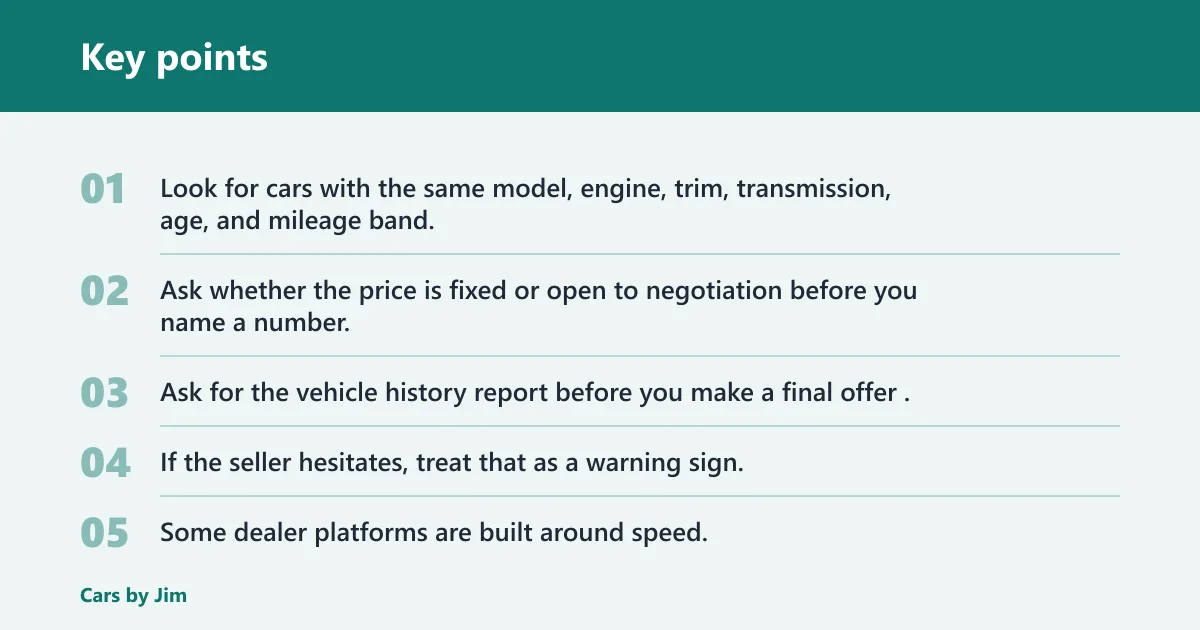
Look for cars with the same model, engine, trim, transmission, age, and mileage band. A car with fewer owners, full service records, and cleaner bodywork can justify more than a rough example, but a poor photo set or missing details usually means you need a bigger cushion in your offer.
Ask whether the price is fixed or open to negotiation before you name a number. Some dealer listings are firm-price, and some platforms time-limit availability, which means the price can move quickly or the car can disappear if you wait too long.
| Evidence to check | What it tells you | How it affects your offer |
|---|---|---|
| Advertised price | The seller’s starting point | Set your opening offer below it if negotiation is allowed |
| Market comparison | Whether the asking price is high, fair, or low | Anchor your number to the live market rather than guesswork |
| Mileage and condition | Wear level versus similar cars | Use defects or higher mileage to justify a lower offer |
| Service history | How well the car has been maintained | Raise your ceiling only when the history is strong and complete |
| Ownership count | How many keepers the car has had | More owners can mean more uncertainty, which supports a lower bid |
Read the vehicle history report
Ask for the vehicle history report before you make a final offer. You want MOT history, accident or insurance markers, service history, ownership count, and any finance status that could block a clean sale. If the seller hesitates, treat that as a warning sign.
Motorway says dealers compete in a daily online sale to buy your car, lists a network of 8,000+ verified dealers, and says its valuation uses live UK market data. It also says most sellers get a price above market value and that sellers get £1,600 more than part exchange on average. Those facts matter because the market is moving, not static.
Spot firm-price and time-limited listings
Some dealer platforms are built around speed. The same source says its auction lists cars to thousands of verified dealers, offers home collection as part of the selling process, and provides same-day payment for sold vehicles. Its service fee ranges from £29.99 to £119.99, depending on the final sale price.
If a listing says “firm,” respect it. Your only useful move may be to ask for written confirmation of what is included, such as delivery, warranty, or a fresh MOT, instead of trying to force a discount that is not on the table.
How do you make the first offer online?
Lead with a specific offer amount, not a vague request for “best price.” Put the figure in writing, tie it to the listing evidence, and state the conditions you need before money changes hands. If the seller accepts, ask for written confirmation of the final price and the deadline.
Set your opening number
Your first offer should reflect the asking price, the market comparison, and any defects or missing history. A common starting point is a modest percentage below asking price when the listing seems fair and negotiation is open; if the car needs work or the asking price is high, start lower. If the price is already firm, do not pretend otherwise.
-
Price the car first.
Compare the listing to similar cars and note any gaps in mileage, history, or condition. Use those gaps to set a number you can defend in writing. -
Choose your opening figure.
Make it specific, such as “about £9,450 subject to verification,” rather than “around nine and a half.” Specific numbers are easier to accept, reject, or counter. -
Set your ceiling.
Decide the highest final accepted price before you message the seller. That prevents emotional bidding after a counteroffer arrives.
Say your target car is listed at £10,000 and similar cars are sitting closer to £9,500, with similar cars sometimes showing cleaner history. An opening offer around £9,200 can leave room to negotiate while still keeping the figure tied to the available evidence. If the seller says the price is firm, that tells you the real question is whether the car is worth the listed amount.
State your conditions in writing
Write the offer so it is conditional on the basics: vehicle history report, ownership count, finance status, and an inspection or video walkaround if you cannot see the car in person. State that the offer is subject to the car matching the listing description and that any acceptance expires at a clear time.
Use a message thread or the platform’s offer form when possible. That creates a record of the price, the date, the terms, and any response. A screenshot alone is weaker than a full message trail.
Choose the right channel on the platform
Use the marketplace or dealer platform’s own message thread, offer submission form, or reserve function if it exists. If the seller pushes you off-platform before the car history, identity, and condition are confirmed, slow down. Payment protection only helps when the deal stays inside the system that supports it.
What should you ask for before you pay?
Before any payment, ask for proof that the car exists, the seller controls it, and the condition matches the listing. That means the history report, service records, ownership count, finance status, identity verification, and a remote inspection plan if you cannot inspect the car yourself. Pay only after those checks are in hand.
History report and MOT record
Request the vehicle history report and the MOT history together, then read them line by line. Look for repeated advisories, mileage jumps, unresolved failures, accident or insurance markers, and signs the car has been moved between owners often. If the history is thin, price that uncertainty in.
Service history, ownership count, and finance status
Ask for dated service invoices, not just a stamped booklet. Confirm the number of previous keepers and ask whether there is any outstanding finance, because a finance balance can stop a clean transfer. If the seller cannot verify ownership or finance status, do not send a deposit.
Suppose a seller offers a glossy set of photos but will not provide the latest MOT record or proof of settled finance. That is not a paperwork quirk. It is a reason to stop, because the missing documents are exactly where the deal can go wrong.
Remote inspection and video walkaround
Use a third-party inspection when the car is expensive, the history is incomplete, or the seller’s answers leave gaps. A live video walkaround should cover body panels, tyres, start-up, warning lights, dashboard mileage, engine bay, interior wear, and any defect the photos hide. Add a contingency that lets you reject the car if the inspection finds material issues.
Do not treat a clean video as a guarantee. It is a filter, not a verdict. The point is to reduce the chance of paying for a car that arrives with faults the listing never mentioned.
Used car offer templates pack
Use these text-only templates to keep the offer specific and documented. Replace the bracketed details before you send them. Keep the tone polite, direct, and tied to evidence.
First-message script
Subject: Offer on [car model, registration]
This offer is subject to the vehicle history report, MOT history, ownership count, finance status, and a video walkaround or third-party inspection confirming the car matches the listing. Please confirm whether that price is acceptable and whether the offer expires today at [time].
Counteroffer reply script
Thanks for the counteroffer of £[new price]. Please confirm what is included at that price, such as any warranty, delivery, fresh MOT, or paperwork transfer.
Offer checklist
- Check the identity. Confirm the seller or dealer name matches the platform listing and the documents. If the identity is unclear, stop before discussing payment.
- Read the history. Ask for the vehicle history report, MOT history, service records, ownership count, and finance status. Missing paperwork is a reason to slow down.
- Verify condition. Request a live video walkaround, close-up photos, and a third-party inspection when needed. Look for defects, warning lights, and signs the car differs from the listing.
- Put terms in writing. State your offer amount, expiry time, inspection condition, and what happens if the car is not as described. Written terms matter more than verbal promises.
- Choose safe payment. Prefer platform payment protection or escrow where available, and avoid sending a bank transfer before the checks are complete. A card payment may offer more dispute options than an ordinary transfer.
- Confirm delivery terms. Ask who delivers the car, when handover happens, and which paperwork arrives with it. The purchase contract should name the final price, delivery terms, and transfer steps.
- Set a walk-away point. Leave the deal if the seller rushes the deposit, changes the price without explanation, or refuses basic proof. A rushed sale is often the wrong sale.
What happens when the seller counters your offer?
A counteroffer means the seller has answered with a new price, sometimes plus extra terms. Read the new number first, then check what is included, how long the counter stands, and whether the change still fits your ceiling. If the window is short, reply quickly or let it go.
Read the new price and what is included
Ask whether the counter includes delivery, warranty, a fresh service, or anything else that changes the real cost. A slightly higher price can still work if it replaces a repair bill or includes protection you would otherwise buy separately.
Do not assume the counter is final. It may be a fresh opening position, especially on a marketplace where several buyers are active. If the seller will not define the final accepted price in writing, the deal is still moving.
Check the expiry window
Many online offers and counters are time-limited. If the seller gives a deadline, treat it seriously. Waiting too long can mean the vehicle is sold to someone else or the price is reset.
Decide whether to accept, revise, or walk away
Accept when the new price stays within your ceiling and the written conditions still protect you. Revise when the car is worth pursuing but the seller needs a clearer number. Walk away when the counter ignores missing history, hidden defects, or rushed payment pressure.
How should payment work on a remote deal?
The safest order is offer, verification, written acceptance, then payment. If you pay before the history, identity, and condition are checked, you lose control. Use bank transfer, card payment, or platform protection only after the paperwork and the car itself line up.
Bank transfer, card payment, or platform protection
A bank transfer is common, but it gives you little room if the deal sours after payment. A card payment can offer more dispute options, depending on the seller and the platform. Escrow or platform payment protection is better when available, because the money is held until the agreed conditions are met.
Renew says its certified used vehicles include a minimum 12-month warranty, 30 days exchange promise, a 150-point mechanical and safety check, and 5 days of complimentary Drive Away Insurance. Those protections are useful only if the car you are buying is actually covered by the programme and the paperwork says so.
Deposit timing and holding payments
Do not send a deposit before the history, identity, and condition checks are complete. If a holding payment is requested, make sure it is written as refundable if the car fails inspection or differs from the listing. If the seller will not commit to that in writing, the payment is too early.
Written terms before money moves
The purchase contract should state the final price, what is included, delivery terms, paperwork transfer, and any cooling-off or return rights if they apply. If the contract does not match the message thread, stop and correct it before paying. A signed contract beats a casual promise every time.
How to buy a used car online
To buy a used car online, find a car that fits your budget, verify the history and identity, inspect it remotely, make a written offer, and only then move to payment and delivery. The safest deals keep the price, condition, and paperwork aligned before the money leaves your account.
Often, the cleanest result comes from staying patient through the paperwork stage. If the seller is honest, they will not mind a written offer, a history check, or a clear acceptance deadline. If they do mind, that is information.
Frequently asked questions
How do I make an offer on a used car online?
Send a written offer that names the car, your price, and the conditions attached to that price. Refer to the listing, mileage, history, and any needed repairs, then add an expiry time. That gives the seller something clear to accept, reject, or counter.
What should I say when I make an online offer on a used car?
Say the price, the evidence behind it, and the checks you still need. Keep it short and specific: the car, the amount, the paperwork you want, and the deadline for reply. Avoid vague lines like “What’s your best price?” because they invite vague answers.
Can I negotiate the price of a used car online?
Yes, if the seller allows negotiation and the listing is not fixed-price. Your position comes from comparable cars, the vehicle history report, service records, mileage, and condition. If the seller has a firm-price policy, negotiate only on included items such as delivery or warranty.
Should I ask for an inspection before I make an offer?
Yes, when you cannot see the car in person or the history leaves gaps. A third-party inspection or live video walkaround can support your offer and protect you from obvious surprises. If the seller refuses any meaningful check, the risk is yours to carry.
How low should my first offer be on a used car?
Start below the asking price, but base the gap on evidence rather than habit. A cleaner car with strong history deserves a smaller discount, while a car with missing records, visible wear, or a high asking price needs more room. Leave space for a counteroffer.
When should I walk away from an online used-car deal?
Walk away if the seller refuses basic history, changes the price without reason, pushes for an urgent deposit, or will not put the conditions in writing. Also leave if the inspection or paperwork exposes a mismatch. The safest deal is the one that still looks sound after checks.