How to Buy a High Mileage Car Without Overpaying
Buy a high-mileage car only if the asking price leaves room for at least the next 12 months of repairs. Cap your offer at comparable market value minus verified near-term fixes, and walk if needed repairs exceed 15% to 20% of that value. A cheap odometer can hide a repair bill that wipes out the savings. This guide shows how to price mileage, service history, and inspection findings into a hard maximum offer.
What counts as high mileage?
For pricing, 100,000 miles is still the main checkpoint, even though many cars keep going well past it. Consumer Reports treats 100,000 miles as the old upper service-life benchmark and says many cars can reach 200,000 miles and beyond. Cars over 100,000 miles are also likely out of warranty. (Consumerreports)
That should change your price target, not your verdict. A 130,000-mile car with regular service and a clean inspection can beat an 80,000-mile car with missing records, warning lights, or clear neglect.
Why mileage matters less than maintenance and design
Mileage matters because it is a proxy for wear, but it says nothing about how the car was driven, serviced, or repaired. Reliability record, parts availability, repair-cost reputation, and feature complexity all change the risk attached to those miles.
A simple sedan with common parts and a strong durability record is often easier to justify at higher mileage than a complicated luxury model with expensive electronics.
Should you buy a high-mileage car?
Buy one when the price reflects remaining life, the service history is credible, and the inspection does not point to expensive work soon. High mileage does not automatically mean trouble, and highway-heavy use is gentler than stop-and-go city driving. The bad buy is the car that needs major repairs before you have even owned it for a month.
High mileage becomes a problem when the price does not account for wear items, repeated repairs, rust, accident history, or weak service records. Then the odometer is hiding cost, not creating a bargain.
How segment choice changes the odds
Sedans with simpler drivetrains usually cost less to keep on the road than trucks, AWD crossovers, and luxury cars. SUVs and trucks can be fine if they have strong records and a sensible price, but their tires, brakes, and suspension often cost more, especially as mileage climbs.
Luxury trims are the riskiest place to hunt for a bargain. Heated and ventilated seats, multiple camera systems, motion-activated tailgates, and other high-tech features can turn a normal repair into a more expensive one.
What records matter most?
Use records to verify that the car was serviced on schedule, not just that it has a stack of paper. Oil changes, filters, brake pads, and major service intervals matter most because they show whether the owner handled basic wear before it became damage. Dealer computerized records can be especially useful because they often preserve dates, mileage, and service types more consistently than loose receipts.
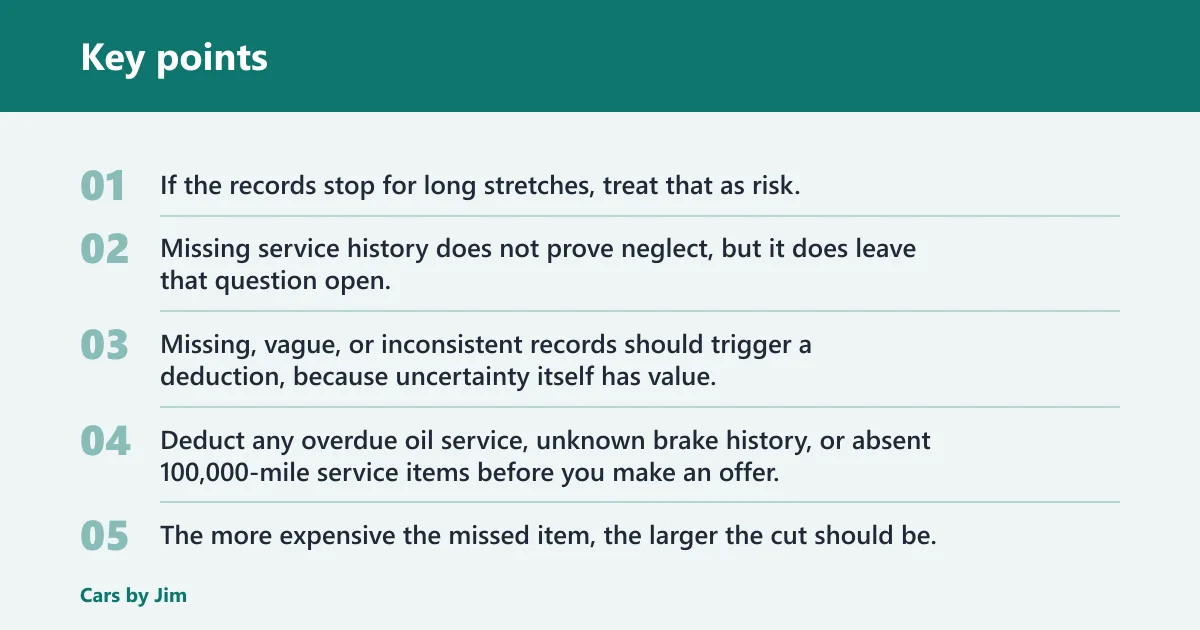
If the records stop for long stretches, treat that as risk. Missing service history does not prove neglect, but it does leave that question open.
What missing records should cost you
Missing, vague, or inconsistent records should trigger a deduction, because uncertainty itself has value. Deduct any overdue oil service, unknown brake history, or absent 100,000-mile service items before you make an offer. The more expensive the missed item, the larger the cut should be.
| Risk item | Typical near-term cost bucket | Deduction if missing, overdue, or uncertain |
|---|---|---|
| Oil changes and filter service | Low to moderate | Deduct the full estimated service cost, plus an extra buffer if sludge or delayed maintenance is visible |
| Brake pads and brake service | Moderate | Deduct the full axle-level brake estimate if pad thickness is unknown or the invoice is missing |
| Spark plugs | Moderate to high | Deduct the full scheduled replacement cost if the 100,000-mile service cannot be confirmed |
| Timing belt | High | Deduct the full belt service estimate if age or mileage puts it near schedule and no proof exists |
| Water pump | Moderate to high | Deduct the full replacement cost when the pump is tied to the belt job or condition is uncertain |
| Coolant hoses | Low to moderate | Deduct the estimated hose service cost if hoses are original, cracked, or undocumented |
| Clutch or transmission wear | High | Deduct a meaningful transmission reserve or walk if symptoms point to an expensive repair |
High-mileage max offer calculator
This is the part most buyers skip. To turn inspection findings into a hard maximum offer, start with comparable market value, subtract verified near-term repairs, subtract anything overdue but unproven, and then subtract an extra reserve for uncertainty. If the total deduction gets too large, the deal is no bargain.
Start with market value. Use comparable listings for the same model, trim, drivetrain, and mileage range. Do not compare a base sedan to a loaded AWD version, because the feature gap distorts the number.
Subtract confirmed repairs. Deduct the documented cost of items the inspection already found, such as tires, brakes, leaks, or worn suspension parts. A real repair need is not a negotiation theory; it is a bill.
Subtract overdue service. If records do not prove that spark plugs, timing belts, water pumps, or coolant hoses were done on schedule, deduct the full expected service amount. Consumer Reports lists spark plugs, timing belts, water pumps, and rubber coolant hoses among the pricier 100,000-mile items.
Add a risk reserve. Keep an extra amount aside for unknowns when the car is above 100,000 miles, has thin records, or has a complex drivetrain. Automatic transmissions can start to show wear near 100,000 miles, and manual-transmission cars might need a clutch around 100,000 miles.
Set your walk-away line. If needed repairs exceed about 15% to 20% of market value, walk. That is the point where the price stops compensating for the risk.
Say a sedan is priced at market value, but the inspection finds bald front tires, front brake pads near the limit, and no proof of the timing belt. In that case, subtract all three costs before you make an offer. The mileage is not the problem; the unpaid maintenance is.
What should the vehicle history report tell you?
A vehicle history report should confirm more than ownership changes. Look for accident history, title issues, odometer tampering, and service entries. Carfax and AutoCheck are the two names many shoppers use here, and Consumer Reports lists a Carfax report at $45 and an AutoCheck report at $30.
Neither report can replace an inspection, but both can expose problems the seller may not mention. If the report shows repeated title brands, mileage jumps, or a gap that does not fit the service timeline, slow down.
Carfax vs AutoCheck
Both can help, but neither is a magic answer. One report may show more service entries while the other may surface auction or title data more clearly. If the car is expensive enough, checking both can still be cheaper than finding a hidden problem after purchase.
Use the report to support your price deduction, not to justify a blind purchase.
What should a pre-purchase inspection catch?
A pre-purchase inspection should look for leaks, suspension wear, transmission behavior, tire condition, warning lights, rust, flood clues, and hidden structural damage. This is where the car either earns your number or loses it. A good-looking body means little if the underside tells a different story.
The mechanic should inspect for fluid leaks, steering looseness, worn shocks or struts, uneven tire wear, and rough shifting. Those are the details that turn mileage into money.
What warning signs mean walk away
Walk away if the inspection finds structural damage, flood evidence, airbag deployment history, heavy rust, or repeated unresolved repairs. One repair can be absorbed into the offer. A pattern of them can turn the car into a money pit.
Suppose a pickup has a clean-looking interior but the inspection finds heavy frame rust and a transmission that flares between gears. That is not a pricing problem anymore. That is a stop sign.
How do you compare two high-mileage cars?
Compare them by remaining useful life, not by sticker price alone. A lower-priced car with weak records, expensive options, and uncertain repairs can cost more per mile than a slightly pricier car with better maintenance and fewer risks. Used-car total cost of ownership should include purchase price, near-term repairs, consumables, remaining useful life, and cost per mile.
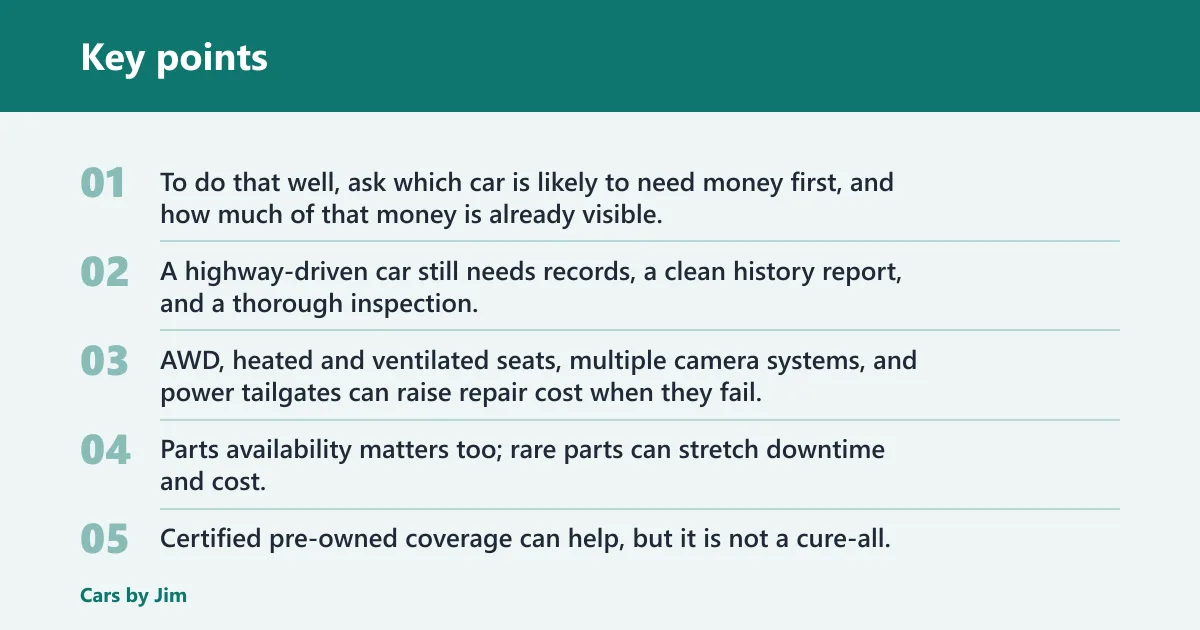
To do that well, ask which car is likely to need money first, and how much of that money is already visible.
Highway miles vs city miles
Highway miles are generally gentler than city miles because they avoid repeated cold starts, braking, and stop-and-go heat. That does not make them risk-free. A highway-driven car still needs records, a clean history report, and a thorough inspection.
A city-driven car with shorter trips and more wear on brakes, suspension, and the cooling system can justify a lower offer even when the odometer is similar.
Why features and CPO coverage change the math
AWD, heated and ventilated seats, multiple camera systems, and power tailgates can raise repair cost when they fail. Luxury cars often cost more in parts and labor, so high mileage on those models deserves a wider deduction than the same mileage on a simpler car. Parts availability matters too; rare parts can stretch downtime and cost.
Certified pre-owned coverage can help, but it is not a cure-all. Check the warranty terms, inspection standards, and age or mileage limits before you pay extra for it. Some CPO programs exclude older or higher-mileage cars, and the coverage may be narrower than the sales pitch suggests.
Frequently asked questions
What is high mileage for a vehicle?
For shopping purposes, 100,000 miles is the main threshold many buyers still use, even though many cars can reach 200,000 miles and beyond. High mileage matters most when it lines up with missing service, weak reliability, or expensive wear items that are due soon.
Does high mileage on a car matter if it was maintained well?
It matters less when maintenance is documented and the inspection is clean, but it still matters. Well-kept high-mileage cars can be smart buys because records lower uncertainty, yet they still deserve pricing for wear items, age-related parts, and the chance that major components are closer to replacement.
How do I know if a high mileage car is overpriced?
It is overpriced if the asking price does not subtract the real cost of repairs, overdue services, and feature-related risk. Use comparable market value, then deduct what the inspection finds, what the records fail to prove, and what the model’s reliability record suggests you may spend soon.
What maintenance records matter on a high mileage car?
Oil changes, filter service, brake work, and major interval service matter most, because they show whether the car got routine care before expensive wear started. Dealer computerized records can help confirm dates and mileage when paper receipts are incomplete or hard to trust.
What happens to high mileage cars around 100,000 miles?
Some of the pricier 100,000-mile items often come due near that point, including spark plugs, timing belts, water pumps, and rubber coolant hoses. Consumer Reports also notes that automatic transmissions can show wear near 100,000 miles, while manual cars may need a clutch around that mark.
Is highway mileage better than city mileage on a used car?
Usually, yes, because highway driving is gentler than stop-and-go city use. Even so, highway miles do not cancel out overdue service, accident damage, or rust. A high-mileage highway car still needs the same records, history check, and inspection before you price it.
How can I calculate the true cost of a high mileage car?
Add the asking price, subtract confirmed repairs, subtract overdue service you cannot verify, and include a reserve for near-term wear. Then compare that total with the car’s remaining useful life and what comparable lower-risk cars would cost per mile over the same ownership period.
What warning signs mean I should walk away from a high mileage car?
Walk away for structural damage, flood clues, repeated repair history, heavy rust, title problems, odometer issues, or transmission symptoms that point to major expense. Also walk if the needed repairs exceed 15% to 20% of market value, because the discount is no longer enough to protect your budget.
Is buying a high mileage car bad?
No, not by itself. Buying one becomes a bad idea when the price ignores condition, records, and expected repair costs. High mileage is only a warning to investigate more carefully and make a lower, evidence-based offer.
Is high mileage bad for a car?
High mileage is not automatically bad, but it increases the odds that wear items and major components are closer to service. The real issue is whether the car has been maintained, whether the design is durable, and whether the asking price accounts for what is likely to need repair soon.
Does high mileage on a car matter?
Yes, because mileage affects the chance of wear, repair cost, and remaining useful life. It matters most when combined with poor records, weak reliability, expensive options, or an inspection that shows leaks, rust, or worn driveline parts. Mileage alone is only one piece of the deal.