Dealer Fees: What They Are and How to Negotiate
Dealer fees fall into two buckets: government charges you usually can’t change, and dealer-created fees you often can; use one rule: negotiate the out-the-door price, then challenge only dealer-controlled lines that duplicate other charges. Miss this split and you can overpay hundreds, sometimes more, while arguing over taxes or registration that the store will not waive. This guide breaks down each common fee, shows how to verify who set it, and explains which charges to question, compare, or negotiate.
What are dealer fees, exactly?

Dealer fees are every charge added between the advertised vehicle price and the full amount due to buy the car. The key split is who controls each line: government charges, manufacturer charges, and dealer-created charges. That matters more than the label, because your bargaining power follows control, not wording.
The difference between advertised price and out-the-door price
The out-the-door price is the full amount due to buy the car, including vehicle price, taxes, title, registration, and fees. It includes everything needed to drive home. Ask for that total in writing, with every line item that builds it, and compare that figure across stores instead of comparing monthly payments.
Used-car shoppers often see the biggest changes after the listing stage. An online price can turn into an emailed quote with a doc fee and add-ons, then a buyer’s order with prep or reconditioning charges, then a final contract with finance-office products. If the total keeps moving, inspect each line item.
The three buckets that matter
Government charges usually include sales tax, title, registration, and state filing charges. Taxes, insurance, and registration fees are not controlled by the dealer. These are usually verified for accuracy rather than negotiated.
Manufacturer charges matter mostly on new cars. The main example is destination, the transportation charge from the factory. New-car destination charges are disclosed on the window sticker under federal law, so destination is not a dealer-created fee.
Dealer-created charges are where most negotiation happens. Dealers may add documentation, acquisition, prep, advertising, and market adjustment fees. On used cars, the most common lines are doc fees, prep fees, reconditioning-type charges, dealer add-ons, and vague admin fees.
Why the fee label matters less than who controls it
A fee called “mandatory” may still be dealer-controlled. A fee called “protection package” may really be an optional add-on. A fee called “market adjustment” is pricing, not a tax or state charge. The first question to ask on every line is simple: who set this amount?
Suppose a dealer lists a sedan for $21,900, but the worksheet adds a $995 documentation fee and a $699 dealer prep charge before taxes and registration. The quote later shows a $799 doc fee, $1,295 paint-and-fabric package, and $495 VIN etching. The label does not settle anything. Control does, and the store likely controls all three.
Which fees are normal, and which ones should put you on alert?
Normal fees usually track a government function or a disclosed manufacturer charge. Fees that should put you on alert are the ones created by the store, especially when they are vague, duplicated elsewhere, or attached late in the process. The warning level rises fast when the charge can be removed.
Usually legitimate charges
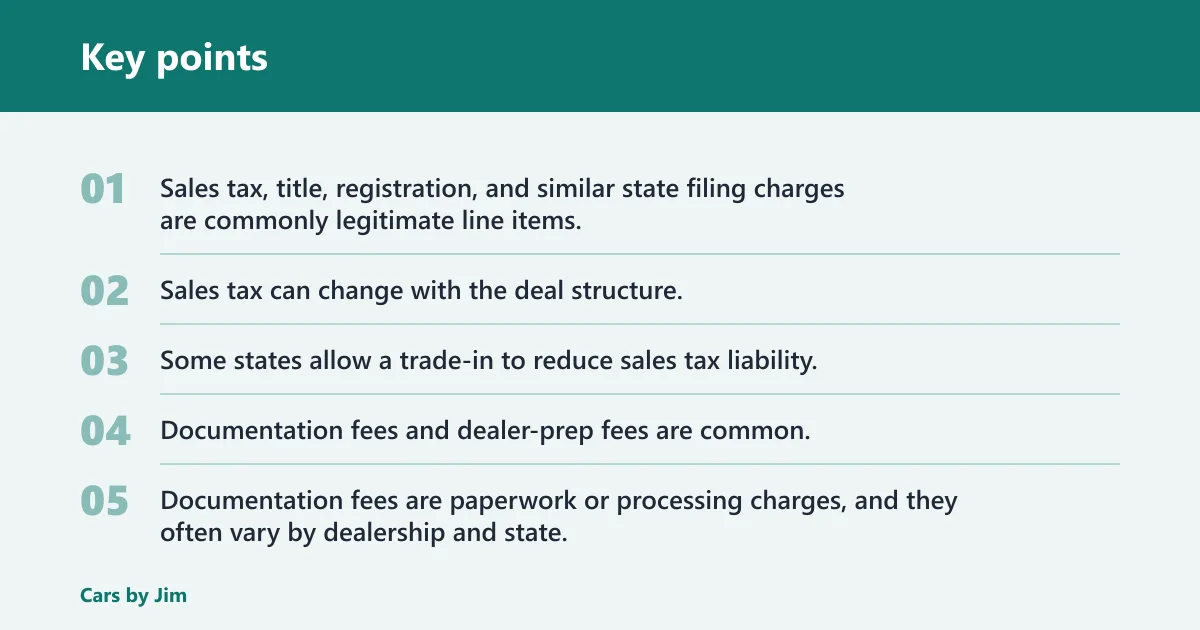
Sales tax, title, registration, and similar state filing charges are commonly legitimate line items. They are tied to legal ownership transfer and plate or registration processing. In normal cases, they are not negotiable, but they should still match the buyer’s address, trade-in treatment, and actual registration situation.
Sales tax can change with the deal structure. Some states allow a trade-in to reduce sales tax liability. A $40,000 car at 10% tax creates a $4,000 tax bill before trade-in credit, so trade treatment can materially change the final number.
Common but dealer-controlled charges
Documentation fees and dealer-prep fees are common. Documentation fees are paperwork or processing charges, and they often vary by dealership and state. Some dealerships charge less than $100 in doc fees, while others charge hundreds. California has a doc fee limit capped at $80. (Caranddriver)
Prep fees need more scrutiny on used cars. A prep charge may reflect cleaning, inspection, or reconditioning, but it can also duplicate work already baked into the selling price. The right response is not “all prep fees are fake.” The better response is “show what work was done, when, and why it is separate.”
High-alert items
Dealer add-ons like paint protection and VIN etching are usually the easiest charges to cut because they are optional, high-margin products that the store or vendor controls. The same goes for fabric protection, wheel and tire products, nitrogen fills, anti-theft products, and appearance packages. These items are often high-margin and removable.
Market adjustment belongs in the same high-alert category. It is a markup above MSRP on high-demand new vehicles, and on used cars it works the same way in substance: it is dealer pricing. Treat it as part of the vehicle price, not as a fixed, quasi-official fee.
A vague admin line is another warning sign. If a store cannot tell you who set the charge, what exact service it pays for, and why it is not already covered by the vehicle price, doc fee, or a state filing, it should not sail through unchallenged.
Which dealer fees can you negotiate or refuse?
Negotiable fees are mostly dealer-created charges, while government charges are usually verified, not bargained down. Some fees can be refused outright, some can be removed if they are optional, and some may hold firm individually but can still be offset through a lower out-the-door total.
Fees you usually verify rather than negotiate
Sales tax, title, and registration sit here. Confirm the rate, the address used, the plate-transfer status, and whether a trade-in credit changes the taxable amount in that state. These lines should be checked carefully, but they usually are not where savings come from.
Destination also usually belongs in the verify column on a new car because it is a manufacturer transportation charge already shown on the window sticker. Used cars generally do not usually have a fresh destination charge tied to the current sale.
Fees you can often remove entirely
Add-ons are the first target. Paint protection, fabric protection, VIN etching, wheel products, theft products, and similar extras can often be removed. Market adjustment can also be challenged because it is dealer pricing, not a government rule.
Finance-office extras can often be refused too: service contracts, GAP, appearance products, and payment-packing tactics that bury products in a monthly payment. If a product was declined on the quote but appears in the final paperwork, it needs to come back off.
Fees that may need an out-the-door offset
Doc fees often land here. Some dealers treat doc fees as fixed, so room to cut that line directly can be limited. That does not mean you are stuck with the same total. If the doc fee will not move, the selling price, trade value, or another dealer-controlled line still can.
Prep fees also may end up in this category if the dealer insists on charging them. The move then is to ask for the work order, challenge duplication, and negotiate the same amount off elsewhere if the fee itself stays on the form.
How should you negotiate dealer fees without losing the deal?

Negotiate fees by controlling the sequence: get a written out-the-door quote first, sort each line by who set it, remove optional add-ons before arguing over hard-to-move charges, and keep every discussion tied to the final total. That approach cuts through fee labels and protects the deal structure.
Out-the-door price is your anchor
Ask for one written number that includes vehicle price, taxes, title, registration, doc fee, add-ons, and every other charge due at signing. Without that number, a low advertised price can hide a high total.
- Request the full quote. Ask for the written out-the-door price, an itemized fee list, tax estimate, title and registration estimate, and any add-on list. Also ask for confirmation that the same numbers will appear on the buyer’s order unless a government fee estimate changes.
- Sort each line by control. Mark each charge as government, manufacturer, or dealer-created. This keeps the negotiation on the lines that can actually move and prevents wasted time arguing over sales tax or registration.
- Attack dealer add-ons first. Remove paint protection, VIN etching, fabric packages, theft products, nitrogen, and similar extras before discussing doc fees. These are usually the easiest dollars to cut because they are optional and high-margin.
- Challenge markups and prep next. Treat market adjustment as price, not a fixed fee. For prep or reconditioning lines, ask what work was done, when it was done, and whether the cost is already reflected in the vehicle price.
- Offset hard-to-move doc fees. If the store will not reduce the doc fee directly, ask for the same amount off the selling price or another dealer-controlled line. This matters because the total is what drains the budget, not the name of the line item.
- Compare totals, not payments. Use the same structure when comparing dealers: selling price, all fees, taxes, and registration. A lower payment can hide a longer term or more products, while the out-the-door price exposes the real cost.
Duplicate charges are where many deals go wrong
Prep fees, reconditioning charges, destination, and finance-office products can overlap with costs already covered elsewhere. Duplicate charges are often legal to list but weakly justified, which is why you should ask what work or product is actually being paid for a second time.
On a new car, a store can charge both destination and prep, but they are different concepts. Destination is factory freight shown on the window sticker. Prep is dealer work. The issue is not whether both can appear; it is whether the prep line is clearly explained and not duplicating predelivery work already paid through another channel.
On a used car, destination should raise eyebrows because there is no fresh factory delivery tied to the current retail sale. A used-car prep fee may or may not be justified, but a “destination” line on the same deal usually needs a very direct explanation.
Picture a used sedan with a $695 prep fee and a separate $895 “reconditioning package.” If both lines describe inspection, wash, and detail work, that is a duplication problem. Ask for dated work orders and a breakdown of parts or labor, not a verbal summary.
At the finance desk, duplication often comes from service contracts, GAP, key replacement, tire-and-wheel coverage, anti-theft products, and appearance plans that reappear after being declined earlier. Payment packing makes this worse by folding products into the monthly payment instead of clearly listing the price.
Dealer fee audit checklist
| Fee name | Who sets it | Negotiable? | Can duplicate another charge? | Exact question to ask |
|---|---|---|---|---|
| Sales tax | State or local government | Usually no; verify only | Not usually, but trade-in treatment can change it | “What tax rate did you use, and does my trade-in reduce taxable price in this state?” |
| Title fee | State motor vehicle agency | Usually no; verify only | No | “Is this the actual title charge for my registration situation, or an estimate?” |
| Registration fee | State or local government | Usually no; verify only | No | “Does this assume new plates, plate transfer, or renewal, and can you show that estimate?” |
| Documentation fee | Dealer, sometimes limited by state law | Sometimes hard to cut directly | Usually no, but it can overlap with vague admin lines | “Is this your standard doc fee for every cash and finance deal, and if it stays, what line in the out-the-door total can move instead?” |
| Prep fee | Dealer | Often yes | Yes; can overlap with reconditioning or predelivery work | “What exact work does this cover, when was it done, and is that work already included in the vehicle price?” |
| Destination fee | Manufacturer on new cars | Usually no on a new car | Yes; can be confused with dealer delivery or prep | “Is this the factory destination charge from the window sticker, or a dealer delivery charge added to this sale?” |
| Market adjustment | Dealer | Yes | No, but it is really pricing | “What changed in this vehicle’s price to justify this markup, and will you remove it if I buy at your quoted out-the-door number today?” |
| VIN etching | Dealer or vendor | Usually yes; often removable | Yes; can overlap with anti-theft products | “Was this already installed, is it optional, and will you remove the charge from the buyer’s order?” |
| Paint or fabric protection | Dealer or vendor | Usually yes; often removable | Yes; can overlap with appearance package lines | “What product was applied, on what date, and can this charge be removed completely?” |
| Service contract or GAP | Dealer or finance office | Usually yes; optional in most deals | Yes; can duplicate existing coverage | “Did I approve this product, and if not, please remove it and recalculate the out-the-door total now.” |
What should you ask for before you visit a dealership?
Before visiting, ask for a written out-the-door quote, itemized fee list, add-on list, tax estimate, and title and registration estimate, then ask whether those numbers will match the buyer’s order. This forces fee disclosure early and gives a clean paper trail when numbers change later.
The documents and screenshots to request
- Save the online listing. Keep screenshots of the advertised price, stock number, mileage, and any note about dealer-installed options. This becomes the baseline when the emailed quote later shows new charges.
- Request the written OTD quote. Ask for the total amount due, plus each line item that builds it: selling price, doc fee, add-ons, taxes, title, registration, and any finance-office products included by default. A verbal “around this much” is not enough.
- Ask for the buyer’s order format. Request a sample or draft buyer’s order with the same numbers before making the trip. That makes it easier to compare the emailed quote to the desk paperwork line by line.
- Question every mandatory claim. If a dealer says a charge is mandatory, ask who requires it: the state, the manufacturer, the lender, or the dealership. Then ask whether every buyer pays the same amount on a cash deal.
- Confirm no payment packing. Ask whether any service contract, GAP, anti-theft product, or appearance product is included in the payment quote. If the answer is yes, ask for a quote with those items removed.
The questions that expose weak fee claims
Ask short, closed questions first. “Who sets this fee?” “Is it the same on a cash deal?” “Can you show where it appears on the window sticker?” “What exact work was done?” “Was this already included in your advertised price?” Those questions make vague charges much harder to defend.
State-specific details matter too. Florida dealer fees are taxed as part of the sales price. A $900 doc fee in Florida adds $54 in state sales tax. Florida Statute 501.976 requires a printed disclosure for separate predelivery service charges, so a buyer there should ask to see that disclosure when a prep line appears.
How fees change from listing to contract
Online listing versus emailed quote
The online listing usually shows the cleanest number. The emailed quote is often where doc fees, add-ons, and dealer-installed products first appear. Compare the stock number, selling price, and any appearance or theft products against the listing screenshot.
Quote versus buyer’s order
The buyer’s order is the first place many shoppers see a prep fee, reconditioning line, or market adjustment that was not clear earlier. Match every number on the quote to the buyer’s order. If a new charge appears, stop and ask why it was absent from the written quote.
Buyer’s order versus final contract
The final finance contract is where optional products often re-enter the deal. Compare the contract against the buyer’s order for service contracts, GAP, anti-theft products, key replacement, and payment changes. If the total or financed amount rises without a government-fee explanation, a dealer-controlled line was added.
A common first-timer mistake is focusing on whether a single fee moved by $100 while missing that the financed amount climbed because GAP and a service contract were folded in at signing. The out-the-door total and the itemized contract catch that immediately.
Frequently asked questions
What dealer fees are normal when buying a car?
Normal fees usually include sales tax, title, registration, and similar state filing charges. On new cars, destination is also a standard manufacturer charge shown on the window sticker. Common dealer charges include doc fees and prep fees, but common does not mean non-negotiable or automatically justified.
Are documentation fees negotiable on a used car?
Sometimes, but often not directly. Some dealers treat doc fees as fixed, so direct room to cut them can be limited even though the amount varies widely by store and state. The practical move is to negotiate the same amount off the vehicle price or another dealer-controlled line while keeping the out-the-door total in view.
What fees should be included in the out-the-door price?
The out-the-door price should include the vehicle price, sales tax, title, registration, doc fee, dealer add-ons, and any other charge due to take the car home. If a store says a product or filing fee will be decided later, the out-the-door quote is incomplete and not ready for comparison.
Can a dealership charge a prep fee and destination fee?
Yes, but only in different roles. On a new car, destination is the manufacturer transportation charge, while prep is a dealer charge for its own work. On a used car, a fresh destination line tied to the current sale is harder to justify, and stacked prep or reconditioning lines deserve close review.
What hidden fees do dealers add at the finance desk?
Common late-added charges include service contracts, GAP, VIN etching, anti-theft products, key replacement, wheel and tire coverage, appearance packages, and payment-packed products buried in the monthly figure. These are usually dealer-controlled. Compare the buyer’s order to the final contract before signing anything.
Should I negotiate the car price or the fees first?
Negotiate the written out-the-door price first, then attack dealer-controlled fees in order: add-ons and market adjustment first, prep and reconditioning next, doc fee through an offset if needed, and government charges last for accuracy only. That sequence prevents the dealer from moving money between lines while keeping the total high.