Can You Find Maintenance Records by VIN?
Yes, sometimes. A VIN can surface maintenance records only when shops, dealers, or fleet systems reported them, and it will not guarantee a full service history. Missing records can hide skipped services, reduce resale value, and make a used car harder to verify. Here’s what a VIN lookup can show, what it usually cannot, and the exact steps to recover missing maintenance history.
What a VIN lookup can show
A VIN lookup can connect you to vehicle history data tied to a specific car, truck, motorcycle, scooter, or moped. For modern vehicles, the VIN is a 17-digit unique code assigned after manufacture; some classic vehicles use shorter formats. You can usually find it on the dashboard near the windshield, the driver-side door jamb, the title, registration, and insurance paperwork.
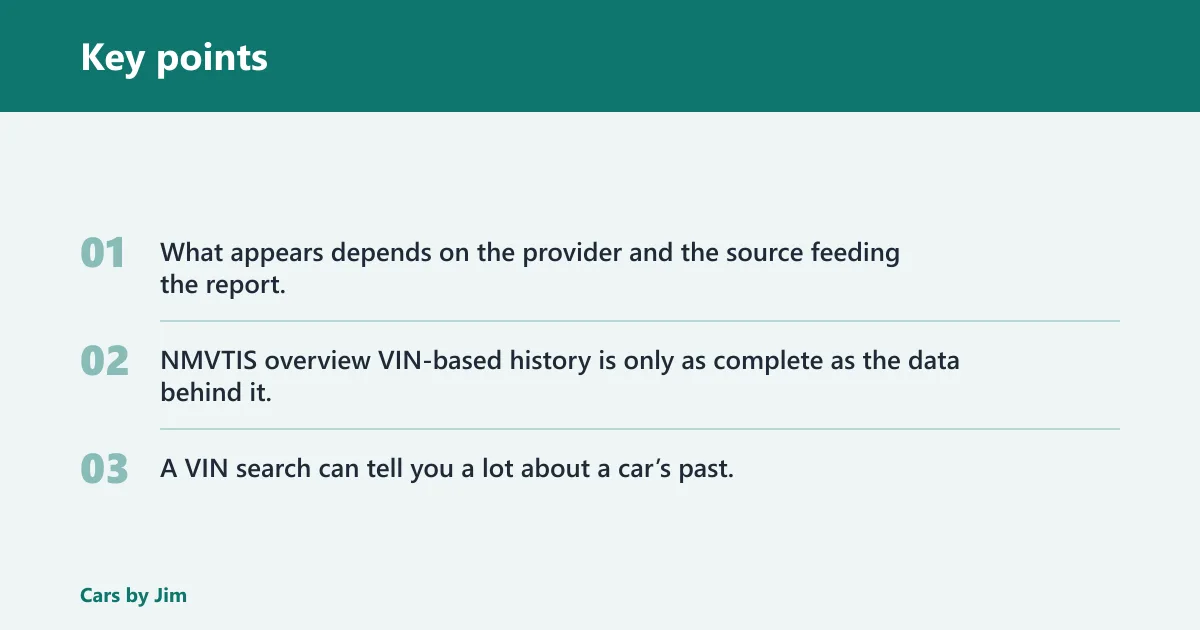
A vehicle history report may include records such as title history, branded titles, accident records, odometer readings, ownership history, theft events, recalls, lien records, damage reports, and sale history. What appears depends on the provider and the source feeding the report. Some approved providers also use NMVTIS, a national vehicle database commonly used for fraud prevention and unsafe vehicle checks. NMVTIS overview
Coverage varies by source
VIN-based history is only as complete as the data behind it. Some search tools pull from title agencies, auctions, inspections, and participating shops, while others add service records or maintenance history only in premium reports. A VIN search can tell you a lot about a car’s past. It cannot promise a full record of every oil change, tire rotation, or brake job.
That matters because a clean-looking report can still miss routine work. A report with title and odometer entries may help, but it is not the same thing as a full maintenance file from the dealer or the previous owner.
Can you find maintenance records by VIN?
Sometimes, yes. A VIN can return maintenance records only when a dealer, repair shop, fleet system, or data provider supplied them to the database. That means a VIN lookup may reveal service records, but it usually cannot guarantee complete maintenance history for the vehicle.
Some reports include only title and ownership data, while others also surface service entries from participating sources. A VIN search can help you spot maintenance patterns, but it should be treated as partial evidence unless you can match it to paperwork from the seller, dealer, or shop.
What a service entry usually tells you
When service records do appear, they often show the date, mileage, and the type of work performed. That helps you judge whether the car had regular oil changes, brake work, fluid services, or scheduled inspections at reasonable intervals.
Partial history is still useful. Three oil changes spaced 5,000 miles apart suggest more care than a report with no entries at all, even if neither proves every service visit. A few documented entries should be read as evidence of some upkeep, not proof of perfect maintenance.
Why are there no maintenance records for some cars?
Many cars have no maintenance records in a VIN-based report because the work never reached the reporting system. Independent-shop repairs, cash payments, and home maintenance often leave no digital trail tied to the VIN. Privacy rules and database limits also block access to some prior-owner service files.
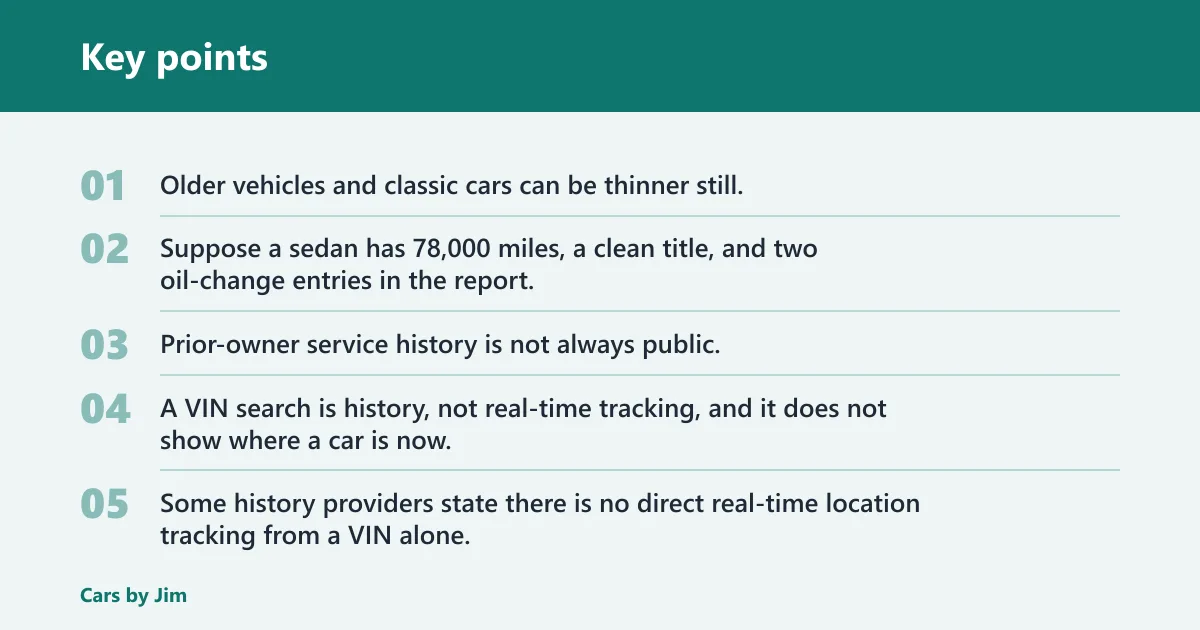
Older vehicles and classic cars can be thinner still. Some history tools note that not every category will have records for every VIN, especially when the vehicle has changed hands often or lived outside major data sources. That does not automatically mean the car was neglected. It means the paper trail is incomplete.
Independent-shop and cash-pay blind spots
Routine oil changes are the biggest gap. A quick lube or local mechanic may not report every visit, and a paid cash repair may never show up in a VIN report at all. If the car was serviced outside participating systems, the history report may look bare even when the owner kept up with maintenance.
Suppose a sedan has 78,000 miles, a clean title, and two oil-change entries in the report. That does not prove the other services were skipped. It may only mean the other shops never shared data.
Privacy and database limits
Prior-owner service history is not always public. Some data belongs to the servicing dealer or shop, and some may be released only to the current owner or through the service provider that handled the work. A VIN search is history, not real-time tracking, and it does not show where a car is now.
Some history providers state there is no direct real-time location tracking from a VIN alone. They also note that VIN data can reveal where a vehicle was registered, auctioned, or repaired. That is still history data, not a location feed.
Older and classic vehicles
Classic and pre-1981 vehicles may use shorter VIN formats, and records can be sparse. Title transfers, auction logs, and mileage checks may appear, but routine service entries are less likely to survive across decades. Use paper records, ownership paperwork, and inspection reports to fill the gap.
What counts as proof of service?
Strong proof of maintenance is dated, mileage-matched paperwork that names the vehicle and describes the work done. Receipts, repair orders, dealer printouts, and digital service summaries are better than verbal claims alone. The closer the mileage and date line up with the VIN report, the more believable the maintenance trail becomes.
| Document | What it should show | Why it matters |
|---|---|---|
| Repair order | VIN or plate, date, mileage, labor, parts, and service description | Links the work to a specific vehicle and a specific visit |
| Dealer printout | Service dates, mileage, and system notes from the dealer network | Helps confirm dealer-serviced maintenance and recall work |
| Receipt | Vendor name, date, amount, and service type | Supports the claim that work was actually purchased |
| Fleet log | Unit number, VIN, date, mileage, and maintenance action | Useful for rentals, commercial cars, and government vehicles |
| Digital service record | Timestamp, vehicle ID, and completed service list | Shows a recorded service event from a shop or manufacturer system |
What counts as proof checklist
- Date and mileage line up with the vehicle’s timeline.
- The document names the VIN, plate, or unit number.
- The work description matches normal maintenance or a known repair.
- The same vehicle appears across multiple records.
- The source is a dealer, shop, fleet system, or documented prior owner.
If the VIN report has no maintenance records, what to do next
Start by matching the car’s likely service source. Dealer-serviced cars, independent-shop cars, fleet vehicles, rental units, and private-party sales each leave different traces. The right next step depends on where the work was done and who kept the paperwork.
Decision tree: what to request when maintenance records are missing
| Scenario | Likely cause | Best next step | What evidence to ask for |
|---|---|---|---|
| Dealer-serviced car | Service was done in a dealer system, but the VIN report did not ingest every event | Ask the selling dealer or brand dealer for service printouts by VIN | Dealer service history, repair orders, recall completion notes, mileage stamps |
| Independent-shop car | Shop visits were not shared with the report provider | Contact the prior owner and ask for receipts or digital invoices | Invoices, card receipts, repair orders, oil-change stickers, inspection sheets |
| Fleet or rental car | Maintenance stayed inside a fleet system or auction file | Ask for fleet maintenance logs or ask the seller for the auction packet | Fleet logs, unit history, auction condition reports, odometer records, service schedules |
| Private-party sale | Owner kept paper records or did home maintenance only | Request the maintenance folder before money changes hands | Receipts, parts packaging, oil-change dates, shop names, registration copies, emissions records |
Ask for the source file. If the car was dealer-serviced, request a printed service history by VIN and ask whether recall work is recorded in the same system. Dealers often see their own records first, but that does not mean they can see every prior-owner repair. For title status and mileage context, a state DMV record can help clarify what the seller’s paperwork leaves out.
Collect paper proof. For independent-shop cars, ask the seller for receipts, repair orders, and inspection sheets. A stack of dated invoices is more useful than a verbal summary because it shows mileage, service type, and the shop name. Ask for service records when they exist and maintenance records when the seller kept a broader file.
Check fleet or auction files. For former rentals, taxis, or company cars, request fleet logs or auction disclosures. These records can show maintenance timing, mileage, and whether the car had repetitive high-use service.
Match dates to mileage. Compare every service entry with the odometer history in the report. A brake job at 61,400 miles followed by an oil change at 67,200 miles makes sense; a claim that the same car had major work at a lower mileage than earlier entries needs more proof.
Decide whether the gap is real. One missing oil change record is common. A long stretch with no receipts, no dealer printouts, and no mileage continuity is more concerning because it suggests either skipped service or no paper trail.
A common first-timer mistake is treating a blank report as proof of neglect. A car with 42,000 miles, two dealer entries, and six missing oil changes may still have been maintained at an independent shop that never reported data. The opposite is also true: a thick stack of receipts with mismatched dates and mileage should be treated cautiously.
Can a VIN lookup show recalls and repairs too?
Yes. Many VIN reports show open recalls, and some also show repair or damage history. Open recalls tell you whether a safety fix was issued, while repair history may show past body or mechanical work. Those two categories are related, but they are not the same as routine maintenance.
Open recalls versus completed recall work
A recall entry can tell you a safety problem was identified. It does not always prove that the repair was finished. If the report shows an open recall, check the VIN through the NHTSA recall lookup and ask a dealer to confirm whether the remedy was completed.
Repair history is different from service history. A repaired bumper or replaced radiator may appear in damage records, while oil changes and scheduled inspections sit in maintenance records, if they appear at all. For theft-related risk, a VIN can also be checked against the NICB theft check.
How do you look up a VIN?
Start with the 17-character VIN on the vehicle, then enter it into a history provider. Some tools also let you search by plate, but VIN is usually the cleaner option because it ties the record to one exact vehicle. If the vehicle is older or classic, confirm whether the provider supports shorter VIN formats.
Finding the VIN on the vehicle
Look at the lower corner of the windshield on the driver side, the door jamb label, the title, the registration card, and the insurance card. The number should match across documents. If it does not, stop and verify before you buy a report or request records from a dealer.
When plate searches may help
Plate searches can help when the VIN label is missing or unreadable, but plates can change with registration or state moves. A VIN is the better anchor for title records, odometer readings, ownership history, and recalls. Use plate searches as a backup, not as the main record key.
Frequently asked questions
Can you look up maintenance records by VIN?
Sometimes. A VIN lookup can show maintenance records only if the servicing dealer, shop, fleet system, or data provider reported them. Many reports include title, mileage, ownership, and recall data, but maintenance coverage is uneven and often incomplete.
Can you look up service records by VIN?
Yes, in some reports. Premium products may include service records, and some providers say their detailed reports include maintenance entries. The result depends on source coverage, so the same VIN may produce full service data in one report and none in another.
Can you check service history with VIN?
Yes, but treat it as a partial check. A VIN search can help you review service history, ownership changes, odometer readings, and title events. It cannot guarantee that every oil change or repair will appear, especially if the work was done outside participating systems.
What maintenance records can a VIN report show?
Depending on the provider, a report may show dealer service visits, shop entries, fleet maintenance, mileage-linked repairs, or recall-related work. It may also show title records, accident records, odometer readings, ownership records, and recalls. Coverage depends on the source and on how the vehicle was serviced.
What should I do if the VIN report shows gaps?
Ask for receipts, repair orders, dealer printouts, and fleet logs. Then compare dates and mileage against the report to see whether the gap is likely a reporting issue or a true service hole. Privacy limits mean some prior-owner records may never appear in the VIN report.