How Do Mileage and Condition Change a Private Party Price?
Mileage sets the floor, but condition moves the price. A clean, documented high-mile car can beat a rough lower-mile one if buyers expect fewer costs in the next 12 months. Miss that balance, and you can price too high or leave money behind. This guide shows how mileage, service history, cosmetic wear, and mechanical condition change private-party value, and how to price for it.
Start with local comparable listings
Start with local or nearby comparable listings, not a national average. Match the same year, make, model, trim, drivetrain, and transmission, then narrow again by title status, accident history, and mileage band so the comp set matches what buyers in your market are actually seeing.
The goal is a realistic market range, not a hopeful number. To gather at least five to ten comparables, then adjust for price, mileage, history, condition, seller type, and likely repairs.
Match the right comp details
Use the same body style and trim first, because trim can move a car into a very different pricing band. Then compare vehicles with similar mileage and similar title status, since a clean-title car should not be priced against a rebuilt-title listing as if they were equal.
Also check ownership and accident history. Two cars with the same odometer reading can land in different price ranges if one has documented damage and the other does not.
Collect nearby listings. Save five to ten ads for the same year, make, model, trim, drivetrain, and transmission. Keep only listings with similar title status and accident history so the range stays usable.
Sort by mileage band. Group the listings into similar mileage bands, then note whether your car sits below average, near average, or above average for age. Mileage matters most when it is compared against the expected use pattern for that vehicle.
Set a starting range. Use the middle of the comp set as the baseline, then move up or down for condition and repair needs. That gives you a real asking range instead of a single optimistic number.
How mileage changes price
Mileage is a pricing signal, not a stand-alone value. Its effect depends on age and the mileage band of the comps, because buyers judge wear against what is typical for the vehicle’s age and how much life they expect to buy next.
Low mileage can help, but only if the rest of the car supports it. High mileage can still sell well when the service records are strong and the condition suggests fewer immediate costs.
Below-average mileage for age
Below-average mileage usually supports a higher ask if the car also looks cared for and the records back it up. Buyers often read low mileage as lower wear, but only when the interior, exterior, and maintenance history agree.
Average mileage for age
Average mileage is usually neutral. It does not automatically raise or lower the price much, so condition and history do the heavier work in the negotiation.
Above-average mileage for age
Above-average mileage often lowers the private-party price, but the amount of the drop is not fixed. A high-mile car with documented maintenance, recent tires and brakes, and a clean title can outprice a lower-mile car that needs repairs or shows neglect.
Suppose two identical sedans are for sale. One has 142,000 miles, fresh service records, and no warning lights; the other has 96,000 miles, worn tires, a brake pulse, and a smoke smell. The higher-mile car can still attract stronger offers because the next 12 months look cheaper and more predictable.
What condition means to buyers

Buyers do not use “condition” as one broad label. They split it into mechanical condition, exterior condition, interior condition, and history condition, then price each part of the car against expected repair risk.
That is why a clean-looking car can still be worth less than it appears if it has warning lights, weak brakes, or a title issue. Good condition means fewer surprises after the sale.
Mechanical condition
Mechanical condition covers the parts that affect reliability and near-term repair cost. Buyers look for warning lights, tire life, brake wear, suspension play, battery age, leaks, rough shifting, and any sign that a repair is due soon.
Exterior condition
Exterior condition includes dents, scratches, paint fade, curb rash, windshield chips, and other visible wear. Small flaws may not sink a deal, but they do soften the ask because buyers know those issues cost money to fix or live with.
Interior condition
Interior condition covers stains, tears, odors, smoke exposure, broken electronics, worn controls, and damaged trim. Interior problems matter more than many sellers expect because buyers notice them immediately and use them as a clue for overall care.
History condition
History condition means title status, accident history, and ownership history. Clean title usually supports the strongest value, while rebuilt or branded title status reduces buyer trust and usually requires a sharper discount, even when the car looks fine.
How mileage and condition adjustment matrix
This matrix turns the combined signal into a practical ask. Start with your local comp range, then move up, down, or hold steady based on mileage band and condition tier. Use the notes to decide how much buyer trust you are likely to earn or lose.
| Mileage band | Clean condition | Average condition | Rough condition |
|---|---|---|---|
| Below average for age | Move up from comp median; support with records, matching wear, and clean history. | Hold near comp median; low miles help, but visible wear should cap the premium. | Move down; low miles do not offset imminent repairs, odors, or title concerns. |
| Average for age | Hold steady or move slightly up if records are complete and wear is light. | Hold steady; this is the baseline most buyers expect. | Move down; average mileage does not protect a car that needs tires, brakes, or body work. |
| Above average for age | Hold steady or trim slightly down if maintenance is documented and wear is mild. | Move down; buyers will expect more negotiation because mileage raises repair risk. | Move down sharply; the market will price in both age-related wear and deferred maintenance. |
| Far above average for age | Hold only if records are strong, title is clean, and wear items are recent. | Move down meaningfully; the car must prove it is not a repair project. | Move down the most; mileage and condition now point to near-term ownership cost. |
Use the matrix as a filter, not a formula. A clean, well-documented car with around 160,000 miles can still price better than a neglected 90,000-mile car if the first one has fresh tires, healthy brakes, no warning lights, and a clean title.
Which wear items move price the most?
Some issues matter far more than others because buyers price them into the first year of ownership. Tires, brakes, battery, suspension, warning lights, body damage, odors, stains, tears, and broken electronics all get attention fast.
Tires, brakes, battery, and suspension
These are among the most visible repair items because buyers can often confirm them quickly. Worn tires, thin brake pads, a weak battery, or suspension play can lower an ask right away, since they point to immediate cash outlay after purchase.
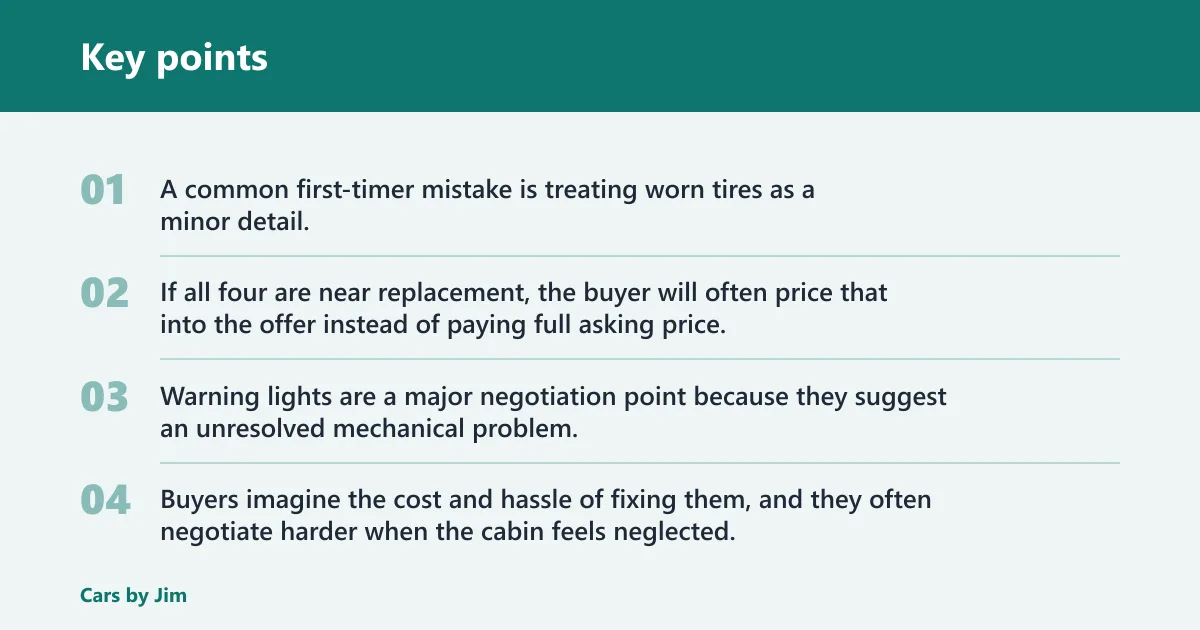
A common first-timer mistake is treating worn tires as a minor detail. If all four are near replacement, the buyer will often price that into the offer instead of paying full asking price.
Warning lights and deferred repairs
Warning lights are a major negotiation point because they suggest an unresolved mechanical problem. Even one illuminated light can move the price down more than several cosmetic flaws, especially if the seller cannot show a recent fix or a clear cause.
Deferred repairs work the same way. A seller who admits the car needs brakes soon, an alignment, or a sensor repair should expect a lower offer than a similar car with those items already handled.
Body damage, glass chips, and cosmetic wear
Dents, scratches, curb rash, paint fade, and windshield chips reduce appeal because they are easy to see and hard to ignore. Cosmetic wear usually does not hit value as hard as mechanical trouble, but it becomes a real price issue when several flaws add up.
Odors, stains, tears, and broken electronics
Interior issues can hurt value more than sellers expect, especially smoke odor, pet odor, stains, ripped upholstery, and nonworking electronics. Buyers imagine the cost and hassle of fixing them, and they often negotiate harder when the cabin feels neglected.
Say your compact SUV has 118,000 miles, a clean title, and service records, but the tires are near bald and the check engine light is on. The low-mile version of that same SUV is not automatically worth more if it still needs the same repairs and the next owner has to absorb them immediately.
How service records support a higher ask
Service records matter most when mileage is high, because they help buyers judge whether wear has been managed on schedule. Oil changes, fluid work, major repair receipts, and timing on recent service can justify a stronger price when they show the car has been maintained instead of merely driven.
Oil changes and fluid work
Regular oil service, coolant work, brake fluid, transmission service, and similar maintenance help support a cleaner story around high mileage. Buyers see those records as proof that the car did not go without basic care.
Major repairs and parts receipts
Receipts for major repairs can move the number up if they cover items that would otherwise worry a buyer. Recent tires, brakes, a battery, suspension work, or a repaired warning light often make the next 12 months of ownership look less risky.
Record completeness and timing
Complete records matter more than vague claims. A file with dates, mileage, and parts details is stronger than a stack of random invoices, and recent maintenance usually carries more weight than old work with no follow-up documentation.
Sort your records. Put service receipts in date order and highlight oil changes, fluid work, tires, brakes, battery, and any major repair. Buyers pay more when the maintenance story is easy to verify.
Match records to mileage. Show that the service timing makes sense for the odometer reading. A car with high mileage and no recent maintenance proof looks riskier than a similar car with documented upkeep.
Use records in pricing. If the car is mechanically sound and the history is complete, keep the asking price closer to the upper part of the comp range. If records are thin, expect buyers to discount for uncertainty.
When higher mileage can still price well
Higher mileage can still price well when the car looks like a controlled risk, not a neglected one. Strong maintenance history, a clean title, no major accident history, and wear that matches the mileage can offset the odometer reading enough to keep the car competitive.
Strong maintenance history
Documented maintenance helps buyers separate normal use from neglect. When the service file is complete and recent, high mileage feels less like a warning and more like evidence that the car was cared for over time.
Clean title and no major accident history
Clean title status usually supports a stronger private-party price because it reduces buyer uncertainty. Prior damage, branded title status, or a rebuilt title almost always cuts into value, even if the car runs well.
Wear that matches the mileage
Wear that looks consistent with the odometer reading is easier to sell than wear that suggests abuse. If the interior, exterior, and mechanical parts look honest for the mileage, buyers are more willing to accept a higher reading.
Imagine a truck with 188,000 miles, complete maintenance records, normal seat wear, and fresh tires. Now compare it with a 111,000-mile truck that has a rough idle, a cracked windshield, and an odor in the cabin. The lower-mile truck can still bring less money if the buyer expects immediate repairs and discomfort.
How to avoid overpricing a used car
Overpricing usually starts when sellers rely on low mileage alone or ignore repair needs. The safer move is to price from nearby comps, then adjust for condition, records, title history, and the actual wear items a buyer can see or verify.
Do not treat a clean look as proof of strong mechanical condition. Do not treat high mileage as automatic damage to value, either. The market cares about the next 12 months of ownership cost more than the odometer alone.
Start from the range. Use the comp range from nearby listings and choose the middle point first. That keeps the price tied to the market instead of to a hopeful number.
Subtract known repairs. Lower the ask for tires, brakes, battery, warning lights, or other immediate work. Buyers usually do this mentally anyway, so pricing them in early reduces wasted negotiation.
Add only verified value. Raise the ask only when records, title status, mileage band, and condition all support it. A higher number needs a clear reason that a buyer can confirm.
Frequently asked questions
How much does mileage lower a private party price?
Mileage lowers price only relative to comparable local listings with similar year, trim, drivetrain, and title status. Below-average mileage can support a higher ask, average mileage is often neutral, and above-average mileage usually lowers value when the car also shows wear or thin maintenance records.
How much does condition change a private party price?
Condition can move a private-party price by a few hundred to a few thousand dollars, depending on the car and the repair items involved. Mechanical issues, warning lights, worn tires and brakes, odor, and title problems usually affect price more than small cosmetic flaws.
What counts as good, fair, or rough condition when pricing a used car?
Good condition means the car has healthy mechanicals, light cosmetic wear, a clean interior, and a clear title history. Fair condition usually means visible wear or a few repair items. Rough condition means buyer-visible problems, deferred maintenance, or history issues that raise near-term ownership cost.
Should low mileage automatically increase my asking price?
No. Low mileage helps only when the rest of the car supports it with strong service records, clean title status, and modest wear. A low-mile car with weak tires, warning lights, or a neglected cabin can still price below a higher-mile car that is better cared for.
How do service records affect price if mileage is high?
Service records help the most when mileage is high because they reduce uncertainty about future repairs. Regular oil changes, fluid work, and receipts for major items like tires or brakes can justify a stronger ask, especially if the records are complete and recent.
Can a well-kept high-mileage car be worth more than a low-mileage neglected one?
Yes. If the high-mileage car has a clean title, strong maintenance history, healthy wear items, and no warning lights, it can outprice a lower-mile car that needs immediate repairs or shows clear neglect. Buyers often pay more for lower near-term cost than for a lower odometer reading.