Used Car Offer: How to Make One and Get It Accepted
Make a used car offer from verified market value, not from the sticker price. For a dealer car that is clean, correctly described and priced within about 3% of strong comparable ads, a first offer at roughly 95% or more of market value is often the realistic lane. For private sales or cars with clear downsides, start lower. Cross-check your numbers with live listings and valuation tools such as Auto Trader car valuation and Parkers car valuation.
The key move is simple: treat the asking price as a starting marker, not a statement of value. Build a fair-market range from similar UK listings, adjust for mileage, condition, MOT history, service gaps, repairs and spec, then fix your maximum walk-away price before you message or call. Use a used car history check, how to inspect a used car guide and a trade-in value calculator separately so you do not blur value, condition and part-exchange numbers.
Start with market value, not the sticker price
Why asking price is only the opening reference point
An advert price tells you what the seller wants, not what the car is worth. Some cars are priced with negotiating room built in. Others already sit close to market because the seller wants a quick sale, knows the market, or has marked the listing as firm price or no offers.
Use the asking price for context. Do not base your offer on that number alone. A car advertised at £10,995 may still be overpriced if comparable local cars with the same engine, trim, year and mileage sit at £10,200 to £10,500.
How to build a fair-market range from comparable UK listings
Check similar listings within a realistic travel radius, then match as closely as possible on year, engine, trim, gearbox, fuel type and mileage. Compare private-sale prices with private-sale ads first, and dealer prices with dealer ads first. Live listing comparisons should then be checked against broader valuation tools, because valuations are only estimates and can vary with local supply and demand; see Auto Trader car valuation, Parkers car valuation and the government’s MOT history service.
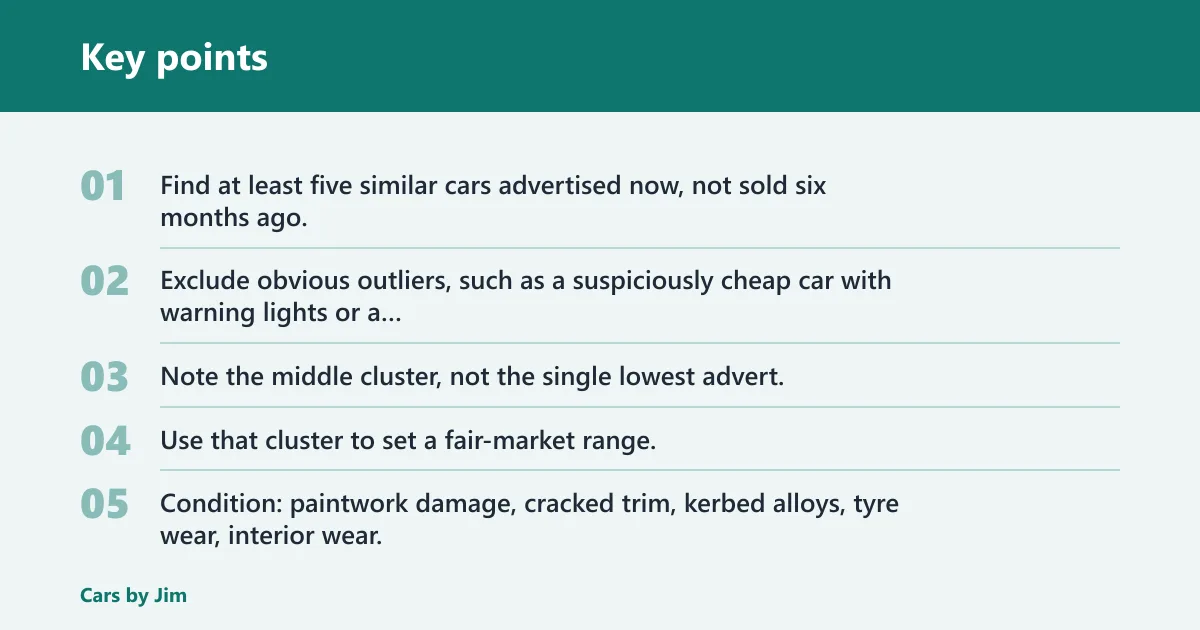
- Find at least five similar cars advertised now, not sold six months ago.
- Exclude obvious outliers, such as a suspiciously cheap car with warning lights or a fully loaded example with rare options.
- Note the middle cluster, not the single lowest advert.
- Use that cluster to set a fair-market range.
Guide prices can help as a cross-check, but live local listings matter more because they show current supply, seasonality and whether a given model is selling quickly or sitting unsold.
The adjustments that matter most: mileage, condition, MOT, history and spec
Once you have a base range, adjust it. Higher mileage than the local average should pull your offer down. Lower mileage can support an offer near the top of the range, but only if condition and service history support it.
Then check the details that change value in a real negotiation:
- Condition: paintwork damage, cracked trim, kerbed alloys, tyre wear, interior wear, warning lights
- MOT history: repeated advisories for tyres, brakes, corrosion or suspension work
- Service history: missing stamps, overdue major services, timing belt or transmission service gaps where relevant
- Vehicle history report: outstanding finance, theft marker, write-off category, mileage consistency, keeper count
- Spec: sought-after trim, factory navigation, safety pack, panoramic roof, tow bar, winter pack, automatic gearbox where that commands stronger prices
A common first-timer mistake is comparing a base-trim private-sale car with dealer stock in a higher trim. If the dealer cars have heated seats, a larger screen and parking sensors, the private advert is not a bargain just because it is cheaper.
When a firm price means your room to negotiate is small
A firm price or no offers listing changes the strategy. It does not always mean zero movement, but it usually means the seller is anchored to a number and may reject anything that feels like routine haggling.
If the asking price already sits inside your fair-market range, go in close to market rather than starting low. If the asking price is still well above market and the seller is firm, that is usually a walk-away case rather than a negotiation project.
What amount should you offer on a used car?
Offer from market value, then choose the band that fits the evidence. Go to about 95% or more of market value only when the car is within roughly 3% of comps and has no meaningful repair or history drag. Start nearer 85 to 90% when the market delta or near-term costs are bigger, and skip bidding altogether when repairs plus overpricing push the car past cleaner alternatives.
The offer formula
Use this simple formula:
Offer basis = fair-market midpoint – immediate repair costs – overdue maintenance – risk discount
The fair-market midpoint is the centre of your comparable listing range. Immediate repair costs are visible or documented items you would need to fix soon. Overdue maintenance covers things like worn tyres, a service that is due now, or a short MOT if it exposes near-term spend. The risk discount is for uncertain history, patchy paperwork, accident markers, mileage concerns or seller behaviour that lowers confidence.
Your maximum walk-away price should sit below the point where the car stops making financial sense against cleaner alternatives. Write that ceiling down before the seller replies. If you decide it in the middle of negotiations, emotion can take over.
How far below asking price to start in three common scenarios
How far below asking price you start depends on market speed and seller type, not a fixed percentage rule. Use this decision tree after you build a comp range:
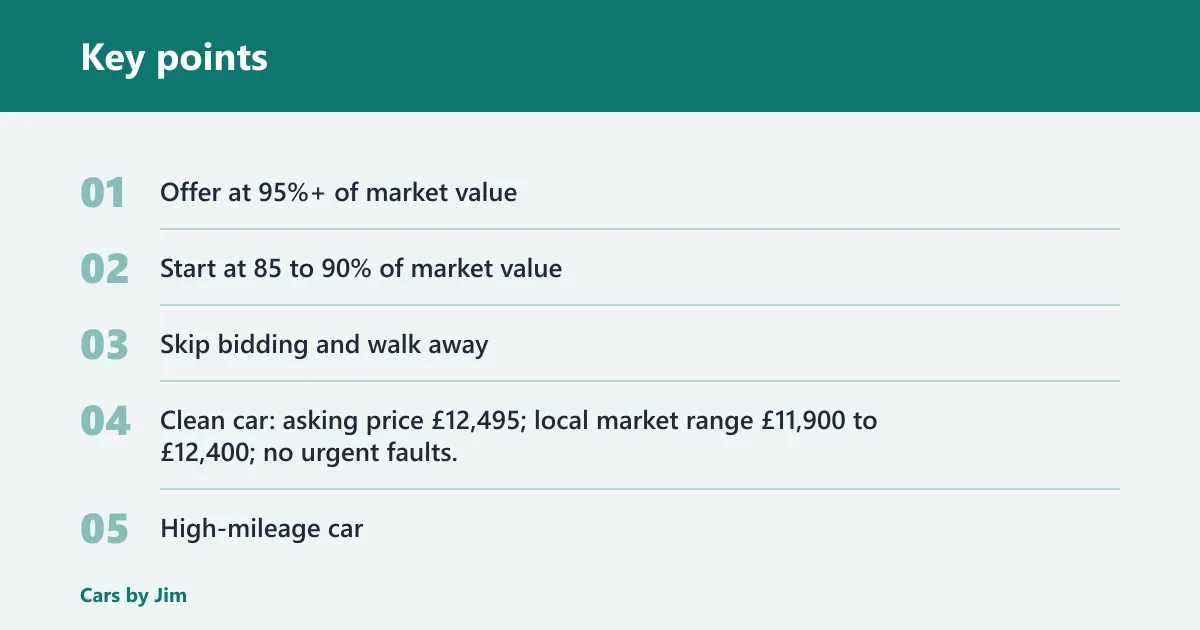
- Offer at 95%+ of market value: use this when the asking price is already within about 0 to 3% of your verified midpoint, the car has full history, a clean or well-explained MOT record, no urgent faults, and the model is in normal-to-fast demand. This is common on tidy dealer stock and well-presented private ads with strong paperwork.
- Start at 85 to 90% of market value: use this when the asking price is about 4 to 10% above your midpoint, when mileage is meaningfully above local comps, or when you can document near-term spend such as tyres, brakes, a service, timing-belt work or cosmetic repair. Private sales often sit here because buyers price in more risk and no dealer prep.
- Skip bidding and walk away: do this when the asking price is more than about 10% above adjusted market value, when immediate repairs and overdue maintenance consume the whole negotiation gap, or when you cannot price the risk cleanly because of missing history, mileage inconsistencies, write-off issues or seller evasiveness.
Picture a tidy estate car with full history, fresh MOT and sensible mileage in a part of the country where family estates disappear within days. A low opening offer may not start a negotiation at all. The seller just moves to the next buyer.
Your maximum walk-away price
Pick one ceiling before the conversation starts and do not move it without new evidence. This is the highest all-in purchase figure that still leaves the car competitive against other available examples after repairs, tax, insurance and immediate maintenance are considered.
Do not include your trade-in here. Keep trade-in value separate from the purchase price so the dealer cannot give ground on one side while taking it back on the other. The government’s DVLA vehicle information service and MOT history service help verify basics before you decide whether a number is still competitive.
Worked example logic
Three quick examples show how the formula works.
- Clean car: asking price £12,495; local market range £11,900 to £12,400; no urgent faults; full history. A first offer around the lower end of market can be credible, with a maximum near the top of the range if the inspection checks out.
- High-mileage car: asking price £9,250; local market range for average mileage cars £8,900 to £9,300; this car is well above that mileage band. Adjust the range down, then open below your adjusted midpoint.
- Repair-needing car: asking price £7,995; local market range £7,700 to £8,100; tyres are near the limit, front discs are worn and there is a service gap. Deduct those near-term costs from the midpoint and cap your walk-away price accordingly.
How do you make an offer without insulting the seller?

A serious offer sounds evidence-led, not clever. Quote comparable listings, mention specific costs such as tyres or overdue servicing, and state a clear number with a reason. If the car is fairly priced, stay close to market; if it is overpriced or risky, show the maths behind your lower figure and your limit.
The first offer that sounds serious
Keep it short. A long speech can sound defensive. A short, reasoned message sounds prepared.
Useful structure: acknowledge the car, cite two or three facts, give your number, state how and when you can proceed.
For example: The car looks tidy, but similar local cars are coming in a little lower, and this one will need tyres soon. Based on that, my offer is £10,350, subject to viewing and the history checks matching the advert.
What to cite
Use points the seller can verify:
- similar listings with close year, trim and mileage
- MOT advisories that suggest upcoming spend
- service history gaps or missing invoices
- tyres near replacement, brake wear, warning lights or visible bodywork faults
- vehicle history report findings such as accident markers, finance checks, keeper count or mileage inconsistencies
A vehicle history report should be checked before you bid seriously. Verify whether finance is outstanding, whether the car has been stolen and recovered, whether it carries a write-off marker, and whether mileage records line up with MOT entries and service paperwork. Any mismatch weakens the case for a strong offer. The used car history check is the quickest way to separate a fair discount from a car you should leave alone.
How readiness can strengthen credibility
A cash purchase can simplify a deal because there is no lender approval or finance paperwork on your side, but it does not guarantee acceptance and many dealers do not value cash as highly as buyers assume. What matters more is being ready to move, having insurance sorted, and showing that funds are in place.
If you can view promptly, make the offer in writing, and avoid changing terms later, the seller sees lower hassle and higher certainty. Private sellers often value that more than a slightly higher but vague offer.
When a low opening offer hurts acceptance odds
If your own research says the car is already at market and the advert is fresh, there is little to gain from an aggressive opening bid. That move often tells the seller you are price-shopping rather than ready to buy.
Suppose a dealer advertises a hatchback at £8,795 and four close comps sit between £8,650 and £8,900. An opening offer at £7,800 is not strategic. It is easy to refuse because the evidence does not support it.
How to set a first offer that still leaves room to negotiate
The safest starting point is to anchor your offer to local market value, then adjust for any real reconditioning or repair costs before you name a number. That keeps you from overpaying and gives the seller a reason to keep talking, instead of shutting the deal down too early. The supporting guide breaks down how to choose an opening bid, a firm ceiling, and a range that fits the car’s demand and seller type.
If you want a practical formula for the first number and your maximum bid, see used car offer guide. It explains how much below fair-market price to start, what to deduct, and how the approach changes for dealers, private sellers, and low-demand vehicles.
Offer worksheet table
Worksheet
| Scenario | Asking price | Fair-market range | Formula | Maximum walk-away price | Walk-away reason |
|---|---|---|---|---|---|
| Clean dealer car, full history, no urgent faults | £12,495 | £11,900 to £12,400 | Midpoint £12,150 = ((£11,900 + £12,400) ÷ 2); repairs £0; overdue maintenance £0; risk discount £0; ceiling set at £12,200 because condition and history support a near-top-of-range buy. | £12,200 | Walk if the seller stays above £12,200 because cleaner comps already exist in the same price band. |
| High-mileage private sale, tidy but above local mileage norm | £9,250 | £8,200 to £8,700 | Base comp midpoint £9,100 from average-mileage cars; mileage adjustment -£650 = adjusted midpoint £8,450; repairs £0; overdue maintenance £0; risk discount £0 to small, so ceiling held at £8,500. | £8,500 | Walk if the seller wants more than £8,500 because the mileage penalty removes the value advantage over lower-mileage alternatives. |
| Dealer car needing tyres, front brakes and catch-up service | £7,995 | £7,000 to £7,400 | Adjusted midpoint £7,200 = ((£7,000 + £7,400) ÷ 2); immediate repairs about £300 tyres + £250 front brakes; overdue service about £150; risk discount partly offset by dealer setting, so ceiling capped at £7,250 only if faults are exactly as disclosed. | £7,250 | Walk if the real bill or undisclosed faults push total cost above £7,250, because the car then loses to better-prepared stock. |
First-offer script
Taking that into account, my offer is £[amount], subject to viewing and the car matching the advert.
Counteroffer response script
Thanks.
Inspection and deadline script
My offer of £[amount] is subject to an independent inspection, a clear vehicle history check, no undisclosed warning lights or accident damage, and the paperwork matching the advert. This offer stays open until [time/day]. Any deposit should be refundable if those conditions are not met.
Can you make the offer subject to an inspection?
Yes. A used-car offer can be made subject to an inspection, and that is often the smart move when the history is incomplete, the price is strong, or faults are hard to judge on a quick viewing. Put the conditions in writing, set a short deadline, and make any deposit refundable if the agreed checks fail.
What an inspection contingency should cover
An inspection contingency means you are agreeing a price in principle, but only if the car passes specified checks. That protects you from hidden faults and from adverts that overstate condition.
Buyer-protective wording should cover:
- an independent inspection by a garage or inspection service
- a clear vehicle history report, including finance and theft checks
- no undisclosed accident damage or write-off marker
- no warning lights, major fluid leaks or serious mechanical faults found on inspection
- paperwork matching the advert, including service record and V5C details
When to use it for dealer cars and private sales
Use an inspection contingency when the car is expensive enough that a mistake will hurt, when the seller is far away, or when the advert lacks detail. It is especially useful with private sales, performance cars, older premium cars and anything with patchy paperwork.
At a dealer, a short inspection window can work because the car is usually on site and easier to book in. With a private seller, be clear that the car should not be treated as sold until the contingency period ends, or that any deposit is refundable if the agreed conditions fail.
Deposits and deadlines on conditional offers
If money changes hands before inspection, make the refund terms explicit in writing. If the seller will not agree to a refundable deposit on a conditional offer, that raises the risk.
A deadline also matters. In a fast-moving market, leaving an offer open too long gives the seller room to use your number against someone else. A same-day deadline or until the next morning is usually enough for a straightforward bid.
What do you say when the seller counters your offer?
Judge the counteroffer against your market range and walk-away price, not against the gap from your first bid. If the counter stays inside your numbers and the car still beats the next-best alternative, a small move can make sense. If it ignores repair costs, history risk or your ceiling, hold firm or leave.
How to read the counteroffer
After a counter, ignore the emotion of the exchange and return to your worksheet. Ask three questions:
- Is the counter still inside my fair-market range?
- Have any faults, history issues or missing paperwork changed the risk?
- Would I still choose this car over the best alternative at this price?
If the answer to the third question is no, the deal is already too expensive.
When to hold firm, raise slightly or split the gap
Hold firm when your offer already reflects visible costs and the seller has not answered those points.
Raise slightly when the car is strong, the seller is responsive, and the new number still sits under your ceiling.
Split the gap only if the midpoint still makes sense against market value. Splitting for the sake of movement is how buyers drift into overpaying.
Why some offers are refused
Dealers may have an internal minimum price below which they will not agree. In practice that can reflect prep spend, warranty cost, stock age, finance structure or the margin needed to retail the car compliantly. The Competition and Markets Authority and the Financial Conduct Authority both stress transparent pricing and motor-finance treatment, which is one reason the headline number and add-on economics are often managed carefully; see CMA consumer protection guidance and the FCA’s car finance information.
That is why a fair-seeming offer can still be refused. The issue may not be your logic. It may be the dealer’s floor.
Private sellers tend to counter from expectation rather than policy. Some need speed and certainty. Others are anchored to what they paid, what they still owe, or a number they believe the car is worth regardless of the market.
When should you walk away from a used car deal?
Walk away when the seller’s best number still leaves the car worse value than close alternatives, when repairs or overdue maintenance erase the apparent discount, or when the paperwork creates risk you cannot price cleanly. If market overpricing exceeds about 10% and the defects are not fully explained, skipping the deal is usually cheaper than rescuing it.
Price signals that mean stop
If the seller’s lowest number remains above your walk-away price after reasonable movement, stop. The market gives you alternatives. Paying too much for the wrong car is usually worse than missing one good advert.
Walk if the seller insists the asking price is fair but cannot support it with condition, history or spec. A price above market can make sense only when the car is clearly better than market.
History and paperwork issues that weaken the deal
Be cautious with:
- outstanding finance that the seller cannot explain clearly
- write-off categories not disclosed in the advert
- mileage records that do not line up
- missing V5C or inconsistent keeper details
- accident damage that appears larger than described
- service books with gaps where major maintenance should appear
Some issues are manageable at the right price. Others create too much uncertainty to price cleanly. If you cannot quantify the risk, walking away is often cheaper than trying to guess.
Seller behaviour that raises risk
Pressure tactics matter. So do evasive answers.
If the seller refuses basic checks, discourages inspection, changes the story on ownership or service history, or pushes for a deposit before you confirm details, treat that as part of the valuation. Risk should lower the offer, and sometimes it should end the conversation.
How to leave the door open
You do not need to argue. State your final number, say why it is your limit, and leave your contact details. If the car does not sell, some sellers come back. Chasing rarely improves your position.
How dealer and private-party offers differ
Where dealers usually have flexibility and where they do not
Dealers can sometimes move on price, admin extras, minor cosmetic fixes or the value of included prep. They may have far less room on the headline number if the stock is fresh, the model is in demand or an internal minimum price is in place.
They also move faster. A good car at a sensible dealer price may attract multiple enquiries the same day, so slow offers lose more often on the forecourt than in private sales.
How private sellers weigh speed and certainty
Private sellers often care more about convenience, reliability of the buyer and how quickly the car can go. A ready buyer who turns up when promised and does not renegotiate without cause can beat a slightly higher but uncertain bidder.
That is why clear timing, proof that funds are ready and a simple written offer can matter. It reduces hassle.
Why trade-in value should be negotiated separately
Keep your trade-in out of the used-car price discussion until the purchase number is set. If the two are mixed together, it becomes hard to see whether you gained on one side or lost on the other.
Set the buy price for the target car first. Then discuss the trade separately.
How online instant offers compare with in-person offers
What you enter and how fast it can work
Online instant-offer tools usually ask for registration and mileage first, then condition and contact details. If a service advertises that users can compare offers in 30 seconds or receive an instant estimate after entering registration and mileage, treat that as a platform claim to verify on the provider’s own page before relying on it in a sale timeline.
Some services also describe a three-step process such as get your offers, book collection, sold, plus no obligation to sell and acceptance of cars of any age, mileage, or condition. Again, those are provider claims and should be checked against the current terms on the platform itself.
Why online offers are useful but different
These tools are good benchmarks, especially if you need a quick floor value for your current car or want a sense of wholesale demand. They are not the same as a negotiated retail purchase offer at a dealer or in a private sale.
Online figures are usually conditional on later checks. The price can change after inspection, condition grading, mileage verification or document review.
Where online platforms fit into your buying strategy
If you are replacing a car and need to dispose of the old one, an instant online figure can help you separate that transaction from the purchase negotiation. Some platforms say partner buyers can settle car finance directly with a lender, which can simplify the sale side before you negotiate the next car.
If a platform says it can sell a car in as little as 24 hours, that collection is free from your doorstep, that buyers are vetted and reputable, or that it has a 4.7 / 5 Google review score, verify each point on the provider’s current page and on the underlying review platform before treating it as a decision-maker. Convenience claims are useful, but they still do not turn an online estimate into a fixed retail negotiation result.
When to use an offer deadline
Whether online or in person, a deadline matters most in fast-moving markets. A short expiry tells the seller you are serious and prevents the offer hanging around while conditions change.
For a straightforward local purchase, a same-day deadline is usually enough. For a car that needs inspection, set the deadline around the booking window and put the conditions in writing.
Frequently asked questions
How much lower than the asking price should I start?
Start from verified market value, then compare the asking price with your adjusted range. If the car is within about 3% of market and checks out well, bid near 95% or more of market value. If it is 4 to 10% high or needs spend, start nearer 85 to 90%. Above that, walking is often smarter.
Can a dealer refuse my offer on a used car?
Yes. A dealer can refuse because the offer is below its internal minimum, because the car is newly listed, or because prep, warranty and finance economics leave little room. That refusal does not always mean your valuation is wrong; it may only mean the dealer’s acceptable floor is higher.
Can I make a used car offer subject to an inspection?
Yes, and it is wise when the price is strong, the history is incomplete or faults are hard to judge on a short viewing. Put the terms in writing, including who inspects, what must check out, how long the condition lasts and whether any deposit is refundable if conditions fail.
What do I say when the seller counters my offer?
Thank the seller, restate the evidence behind your number, and check whether the counter still fits your market range and walk-away limit. If it does, move slightly if needed. If it does not, give your final figure, keep the reason brief, and stop there.